David Woodhouse has been widely recognized for his architectural work in the Chicago region for a series of innovative public projects that reflect, respect, and celebrate the values of the communities his designs serve.
He received his BArch from the University of Illinois at Urbana-Champaign in 1971 in a program that included study at the École des Beaux-Arts in Versailles, France. He then joined Stanley Tigerman and Associates in Chicago, where he became an Associate before leaving in 1978 for Booth/Hansen and Associates, where he was Senior Associate and Vice President. In 1987, he founded a partnership that became David Woodhouse Architects in 1990. He was advanced to membership in the College of Fellows of the American Institute of Architects in 1999. In 2007, David Woodhouse Architects received the AIA Chicago Firm of the Year Award, before becoming Woodhouse Tinucci Architects in 2014.
His projects have been recognized with multiple design and historic preservation awards, publications in architectural periodicals and books, and exhibitions in the US and abroad. He has served on numerous architectural design and historical preservation award juries, has contributed articles to several architectural periodicals, and has been a faculty member at Archeworks. He is an Adjunct Professor in the Illinois Institute of Technology’s College of Architecture as well as a frequent lecturer and visiting design critic at other universities. David is a member of the Board of Trustees of the Cove School for children with complex learning disabilities. He has served on the Board of Trustees of the Ragdale Foundation, the Board of Directors of Landmarks Illinois, the Advisory Design Council of the School of the Art Institute of Chicago, and the Chicago Advisory Council of Lake Forest College.
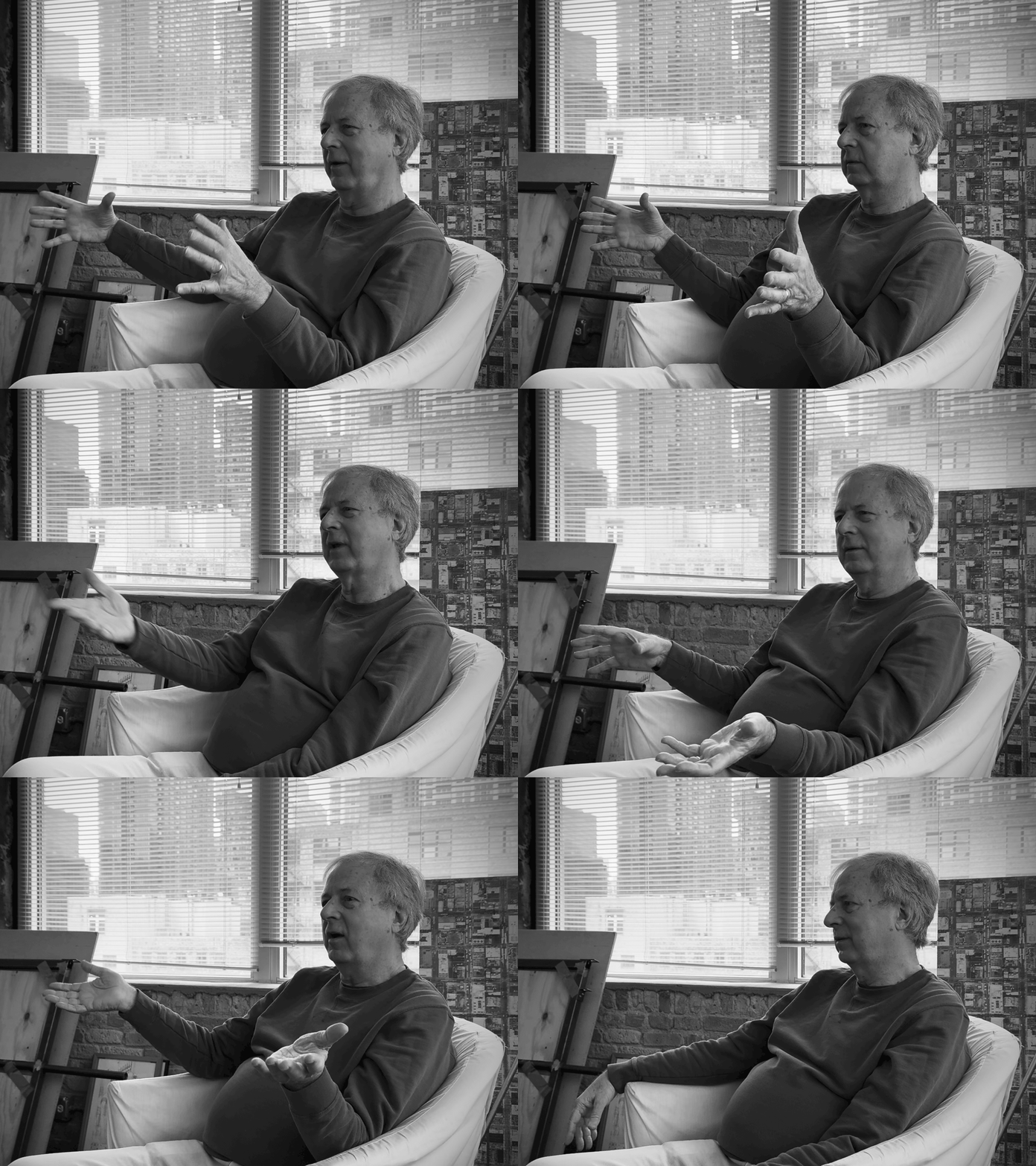
IG: Thank you for being able to meet today. We are here to conduct your oral history in a chronological order. Let’s start with when and where you were born.
DW: I was born in a little town called Streator, Illinois, which is south of Ottawa. My mother’s family is from there, and my grandfather was the surgeon in town. We all went up there to get delivered. But I grew up in Peoria.
IG: When were you born?
DW: May 15, 1948.
IG: What did your father do?
DW: He was a food broker. He worked for his father. Their business represented big food companies. They were the middle people between big food companies and restaurants and food stores.
IG: What was your father’s name?
DW: His name was James, but everyone called him Woody.
IG: Was he also from the area where you grew up in?
DW: Yeah. My dad’s family was from Michigan and then they moved to Peoria around 1925.
IG: What was your mother’s name and what did she do?
DW: Her name was Phyllis. She was a housewife.

James and Phyllis at their home in Peoria, Illinois. Courtesy of David Woodhouse.
IG: Do you have any siblings?
DW: I have a younger sister named Jayne and a younger brother named Mike.
IG: Are you close in age with them?
DW: Five years total.
IG: Can you describe the neighborhood where you grew up in and your experience in those early years?
DW: Peoria was, at that time, a nice town. It isn’t so much anymore. We grew up in the north side, and it was a lot like Winnetka and those towns. There were big winding streets along the river bluff, with big houses and that kind of thing. It was almost a gated community. I mean, it wasn’t gated, but it was self-contained.
IG: Did you travel with your parents to any memorable places?
DW: Yeah, we went all over. My parents dragged us out West. My dad was a Western guy. He went out there for dude ranch when he was a child. He loved westerns. We did that and then my grandparents took us to Europe. You would do it on the ocean liners. It was really fun.
IG: Where in Europe did you go with your grandparents?
DW: To the Mediterranean, up to Italy, Austria, and around.
IG: Did you go to high school in Peoria?
DW: Mm-hmm.
IG: What was the name of the high school?
DW: Richwoods High School.
IG: Were there any aspects during high school that were relevant in terms of your later career in architecture?
DW: What it was for me was that I grew up when, even in a place like Peoria, there were architects. They lived there; they worked there. They designed all the buildings, not like today. There were people designing buildings. There were two big architecture firms, and we lived across the street from the partner of one of them. His name was Eugene Swager and his firm is called PSA [Phillips and Swager Associates], and it still exists in some form [In 2004, Dewberry acquired Phillips and Swager]. My dad’s best friend from high school, Bob Dageforde, was also an architect. When my parents built their dream house, they hired Swager to design it. They bought two lots beside an enormous forest preserve and built a really, really nice home. It wasn’t the Barcelona Pavilion, but it was actually a very handsome kind of California modern, tremendous place to grow up in, kind of house.

High Point Rd, Peoria, Illinois. Courtesy of David Woodhouse.

High Point Rd, Peoria, Illinois. Courtesy of David Woodhouse.

304 East High Point Rd, Peoria, Illinois. Courtesy of David Woodhouse.

304 East High Point Rd, Peoria, Illinois. Courtesy of David Woodhouse.

304 East High Point Rd, Peoria, Illinois. Courtesy of David Woodhouse.
When I was six years old, that is what they were doing. I was in those meetings with my parents and that was where you saw it. You saw architecture. We moved there and it turned out that my girlfriend was the daughter of one of the partners of the other big firm [Jim Terry of Lankton, Ziegele, Terry & Associates]. All the partners lived nearby. Architects were just a normal thing.
IG: They were part of the fabric of the community.
DW: Exactly. It wasn’t foreign. It wasn’t odd. It was part of the thing. These are the architects that built my dad’s office building. They built our high school. They built the church we went to. They touched you every day. It was just there. I think architects don’t really exist like that in the public mind now. I was lucky because it was always in front of me; I could see it, and I really liked it even when I was a kid.
IG: That your parents would commission an architect to do their house would be fairly unusual today.
DW: Today is a freakish thing. My parents were totally normal people. They weren’t socially ambitious. It wasn’t that thing. It was just the time. My dad and mom were born in 1924. My dad was 17 when the Japanese attacked Pearl Harbor. They shipped them off and their lives were derailed by the war. But the thing was that you were fighting it for a better world, a better life. Architecture and the arts were main participants in that. Architecture was socially ambitious, and they were caught up in that. My mom grew up in just a canonical big, white, symmetrical mansion kind of house. It was totally traditional. Once she told me, “David, that is what I really want.” But what they did was a modern house because, at the time, the promise was architecture. Being modern and the future is now embodied in your phone. I was fortunate to be able to grow up in the middle of that. That touched you even in a place like Peoria.
I wanted to be an architect since I can remember wanting to be a cowboy, all your childish things. When I was probably eight or nine years old, for Christmas my dad and his best friend architect went to Illinois Blueprint in Peoria. It was a printing company, but you could buy supplies there. They bought me a professional architect’s table with T-Squares, pencils, scales, and all that stuff. I still have my original scale; all the numbers are almost worn off. I would draw house plans on freezer paper. That was the only paper you could get. I would design houses, and I had my parents’ blueprints. I had the specs, everything. I still have them.
When I was eight or nine years old, I was drawing sections, and I had the little section marks because I had the blueprints as a model. At the time, you could buy house plan magazines in grocery stores. It was “100 Wonderful Ranch Houses” or something like that. I would buy those instead of comic books. I would sit there with my mom and say, “This doesn’t work. The bathrooms are too close to the kitchen.” I was just a total nerd.
IG: You really had an early education in architecture.
DW: Yeah. I was very fortunate because, especially nowadays, the college education doesn’t have all that much to do with what one does in life. You go get a degree in French literature and then you decide what to do. For me, it was like a square peg-/square hole thing, so I just knew.
IG: Were any of your friends at that age also inclined to be an architect?
DW: No. No.
IG: When you went to high school, you already had several years of “self-education.” Were there classes that were particularly relevant?
DW: There were drafting classes that culminated in a thing that was called “Architectural Drawing.” I couldn’t take those courses because that was a non-college thing. That was for people who were “too dumb” to go to college. At that time, it was a very, very hierarchical educational system. If you were in college prep or something like that, you were all in advanced history, physics, and stuff and you couldn’t take those courses. That was industrial education. I wanted to take the architecture course at the end. You would take it during your senior year, and I had to go to the school board to get approval for it because I didn’t have any of the prerequisites because I hadn’t pursued that path. There was a whole wing of the high school devoted to guys who were going to work on cars.
IG: I see.
DW: It was a very class-based educational system.
IG: There was a clear split in career paths.
DW: Yeah, exactly.
IG: Were you able to take that class?
DW: Yeah, in the end I was able to take that class. We each had to design a house, and I could still draw you the house I designed today.
IG: From the time you were eight and nine years old and you were doing those drawings to graduating high school, did you continue to draw things?
DW: Yeah.
IG: What was next after you graduated from high school?
DW: Then you have to go to college, and I don’t know anything about architecture schools; I’m just an idiot from Peoria. All the architects I knew were our neighbors. I mean, I knew my girlfriend’s father really well. They were really mentoring in a way. They had all gone to the University of Illinois. My parents went to the University of Illinois. My dad is looking at Harvard University and the cost of U of I, which is $300 or something like that, and 90 miles down the road. That is a pretty powerful factor, so you just went there. It wasn’t a thought. It wasn’t like you could look at architectural education and decide where to go; it was just an automatic decision. It was just the thing you did, which is how I wound up here.
IG: Besides the architects that were in Peoria, were you aware of other architects that were based in Chicago or other cities?
DW: No, not really. I suppose I knew Frank Lloyd Wright or something. He was still alive then. He was in Life magazine every week. He was an icon. But I didn’t understand what architecture was as a profession. I just liked it. It is the things that speak to you. I have a cousin who is a costume designer. When he and I are together, I am always walking around looking at the buildings. I am never looking at him. He is always looking at you, but never your face, always your clothes. He’ll just reach over and straighten something. You interpret the world in a particular way. You find meaning to explain the world to yourself. For me, that turned out to be architecture. I don’t know much about anything at all. Everybody wanted me to be a doctor; my mother’s family was all surgeons, so they all thought, “Oh my God, he’s going to be a doctor.” I had to fight that, but architecture was okay too. It was mainly a social ambition thing, not thoughtful.
IG: What year did you go to high school?
DW: 1962. I graduated in 1966.
IG: And then you went straight to U of I.
DW: I went straight to U of I, which was a five-year program at that time. I graduated in 1971. Our class was the second to last without a master’s degree. When I went to school, you did five years for a bachelor. No one got a master. The people who got a master’s degree were people who wanted to write books or something. It was truly a different thing.
IG: Can you talk about U of I at that time? Who was teaching then? Who were faculty that stood out to you?
DW: It was tough. I was a terrible student. In a way, I blew off college because I was really immature. This was during the Vietnam War. The classes were canceled. The whole last half of our education was about protesting war. If you went to class, that is what you did; that is what you talked about. Looking back, I was just growing up and stuff, so I was really bored with school. I really was bored with school. I thought it was terrible. I can see now that it obviously wasn’t. Carol Ross Barney was in my class. Ralph Johnson was in my class. Look what they are now. They were that then too. It wasn’t a bad education, but it wasn’t exciting to me at all. It never occurred to me that architecture would be any different anywhere else. I didn't know anything.
IG: Do you think this experience was partly your personal growth?
DW: Partly it was my personal issues, just being an irresponsible, young person. You are working out how to live. I had never had freedom before, you were dating. It was a whole new world and that swallowed a lot. I can now see that that was deflecting from an educational standpoint, and I just didn’t know what to do. I was bored with what they were doing.
IG: Were the classes also not appealing to you?
DW: I don't know. I don't know how to explain it. It was me, not them. It was obviously a perfectly good education. Look what came out of it; Andy [Tinucci] went there. I mean, it was fine.
IG: You mentioned that Carol Ross Barney and Ralph Johnson were in your class. Did you spend time with them?
DW: Yeah, because it was a small class. I believe that when we graduated, we had fifty-nine graduates, and we were the second largest class in the US. My brother-in-law, who died a couple of weeks ago, was an architect too. He went to Rice at the same time that I did, and they had eleven people in the year. Architecture school was just a very small group of people. Carol, Ralph, and I were together all the time. They weren’t one of 800 people that you sometimes bumped into in the hall. You spent five years together. We are actually still pretty tight now.
IG: When you were at U of I, did you do study abroad? Was there exposure to other places?
DW: There was a Versailles program at the time. We were the first group in Versailles. U of I had a program on the French Riviera in a place called Mandelieu-la-Napoule and they were thrown out of there because so many people had gone to Spain and bought drugs or whatever they did. It was those years. As a just “what are we going to do?” kind of thing, they put us in Versailles. Do you know about that program?
IG: A little bit.
DW: Across the big courtyard at Versailles were two stable buildings; we were in the left-hand one, the Petite Écurie. This was 1970, shortly after ’68 in France. They had broken apart one of the big architectural schools in France to decrease its political importance. They parked them there, and the building was under construction. We never had heat. I mean, it was really, really rough. The structures class was taught by a guy named Hornbeck. You would go in there and he would teach you about plate girders. The big deal was whether you could listen to the Rolling Stones during class or not. All the other classes just said, “Go out, go.” They never took you anywhere, but they just said, “Get out of here.” It wasn’t academic at all, but it was totally life-transforming. I am a kid for Peoria, and I am in Paris, and it was Paris when it was cheap. Another student, Tom Reddy, still a good friend of mine, and I bought a car for $95. It was an old Renault Ondine you had to push to start. We put thousands of miles on this thing. We went up to Finland, down to Spain, because that was it. We just went out and explored architecturally, too.
IG: I can imagine that this experience was transformational.
DW: That was worth more than school. It was phenomenal. It was just absolutely phenomenal.
IG: Were the teachers from France or part of another school?
DW: No, they were all from the US. They were our professors taken over there. The only one that wasn’t was a Danish guy named Mogens Prip-Buus. He was Jørn Utzon’s right-hand man on the Sydney Opera House. He was the star. He had an eponymous firm down on the Riviera and, if you were really one of the bright ones, you could go and work for him for a couple of years. Tom Reddy and Bob Fugman both did that. Everybody else was a professor from our school who were sent over there.
IG: When you traveled across Europe, were there particular buildings that you looked for? Did any of the faculty open the door to visit them?
DW: They just kind of disappeared, frankly. I mean, they were doing their own travel. We knew what we wanted to see, like all the Le Corbusier stuff. In those years, those people were big, but Villa Savoye was a ruin, Barcelona was a ruin. We went down to see projects by Gaudi, and it was all smashed. It was dangerous. The park [Park Güell] was freaky. There were smashed tiles and discarded drug needles all over the place.
IG: It was very different then.
DW: It was wrecked, but you knew. We were serious about it compared to people now. Europe had a valence for Americans, culturally. It was so strong. I mean, my grandparents took us over there. They were regular folks from Illinois. You had to go to Europe. You had to go see those things. It was maybe five years later that that had all changed, because my younger sister and brother were completely immune to it. Now kids don’t care at all. They could walk past the Pantheon every day and never go in. They have no curiosity, but back then, you just had to see those things and you knew what they were. We had had good architectural visiting courses through that, including modern buildings. It wasn’t just old churches, but it was old churches too.
IG: That was 1970 so you had one more academic year after coming back from Versailles.
DW: Yeah. We came back to Champaign and had a final year there.
IG: Did that trip change the way you approached your last year in school?
DW: The last year for me was a complete waste. It was partially because I got married halfway through it. It was just your whole focus. To come back to Champaign for an extra year was lunatic. We were getting married and working that out; the final year was an anti-climax.
IG: You graduate in 1971, and you get married. Where did you go next?
DW: Again, it was just automatic: you came to Chicago. We never considered any other place. We grew up in small town; my wife lived in Peoria too, ten miles away. Both of us grew up knowing we would not live there permanently. There was no question about going home. You knew you were going to go live in a city and live in a city was an odd thing there. We had some explaining to do to our parents. “You are what?” In 1971, Chicago wasn’t the city that you see now, but we never considered any other city. Chicago was up there, and we knew architecturally Chicago was a roaring thing. It was marvelous. Not that isn’t now, but it was a powerhouse. You just thought, “That’s where we want to go.”
IG: When you are saying you are coming here to Chicago, what were the architecture practices that you thought were interesting at that time?
DW: The only ones I really knew were the big firms. Skidmore [Skidmore, Owings & Merrill] would come down to Champaign. They had just finished the John Hancock Center, the Sears Tower, and all this stuff. That is what you knew. I didn’t know any of the smaller firms, which were the better ones from my point of view.
IG: You knew the big ones because they came to Champaign.
DW: Yeah, they came down to lecture on their work. My brother-in-law, who was also an architect, and his wife (my wife Marsha’s older sister) had just moved to Chicago too. He worked for Murphy [C. F. Murphy at the time]. He was the only architect I knew because almost none of the students that I knew moved here.
IG: Where did they move?
DW: They went around. We lost touch. We weren’t together. Maybe I was not part of it, was probably a better way of saying it. When I came here, I didn’t know anything. I knew five big firms. I knew Mies had just died, that kind of thing.
IG: Did you apply to the big firms?
DW: No, because I didn’t want to be in a big firm. That I did know. I just don’t have that head, but I didn’t know anything about where to go. I really did just work my way through the phonebook. My first job lasted three years and was horrible, absolutely horrible. Pete Landon was there. Ed Uhlir was there. That is where we all met. You could torture us, and we wouldn’t tell you what it was. Their work was mainly sewage plants.
IG: Without torturing you, what was the name of the office?
DW: You would have to torture me. There was a firm called Consoer & Morgan, and it was the architectural arm of Consoer, Townsend & Associates, which is now CTE. They did Meigs Field Terminal and Ravenswood Hospital, but it was primarily engineering projects.
IG: I see.
DW: It was terrible. It was unbelievable how horrible it was, but you learned a lot because you were just thrown into it.
IG: It is interesting that Pete Landon and Ed Uhlir were also there.
DW: None of us nearly knew anything in a way. It is hard to describe how stupid I was. I just didn’t know because it was all really done through some sort of personal networks. I didn’t really have that much, obviously.
IG: That was your first exposure after graduating in 1971.
DW: Yeah, I was there for three years. Finally, I quit, and we had bought a house, and we were up in Lincoln Park in a place we remodeled. This was the time that [Robert Venturi’s] Complexity and Contradiction in Architecture had come out, which of course at the University of Illinois we had never heard of. We had never heard of the Five Architects [Eisenman, Graves, Gwathmey, Hejduk, and Meier]. Those didn’t reach corn country. It was discovering books like those that I was like, “Holy Christ, this is much bigger than I had imagined.”
My wife and I had decided we were going to either move to Philadelphia or Boston. We wanted to get out of Chicago. I went to Philadelphia, and I wanted to interview with Venturi. I walked around the block for three hours. I obviously didn’t talk to him, but I did talk to a very nice woman. The key thing she told me was that “we are not going to hire you. But [James] Stirling is giving a lecture tonight at Penn, so you should go.” I thought, “Things like this exist, really?” We never did anything. We came back here, but I came back with a different brain. I was educated late. I’m the latest of bloomers.
IG: It showed you that there was another way of practicing.
DW: Yeah, there was another way. I was so immature. I wasn’t capable of understanding what I was being offered in school. I don’t blame it on school. I believe it was my fault. It was me. But, at some point, you did get on the right track not just professionally, but one that really was exciting to you, meaningful to you. Actually, I believe in this. This is real.
IG: You have this experience in school, then you go to a very practical architecture office.
DW: Yeah, just nuts and bolts. But it was a great place to get a technical education.
IG: And then, suddenly, you are chasing Robert Venturi in Philadelphia, and you attend a James Stirling lecture. You see that there is something else.
DW: Yeah, I didn’t know that world existed. I honestly didn’t. As an intellectual enterprise, I didn’t know that that was there.
IG: How does that experience transform you when you come back to Chicago?
DW: I went through the phone book again, but I knew more so I could skip. I got to [Stanley] Tigerman. I didn’t have a real firm idea of his work, but I knew he existed. I had heard of him. I called and the secretary said, “Yes, come on in.” I talked to him, and he had an opening for somebody that was just to do construction administration on the Prairie Brook apartment project out in Palatine. You weren’t even going to come to the office. I showed him my portfolio, and he said, “This is shit.” He asked me what I made at Consoer. I told him. And he said, “It’s way too much.” And I said, “It’s combat pay.” And he hired me. It was unbelievable. It was just unbelievable.
IG: What year did Stanley Tigerman hire you?
DW: 1975. I was so awed. I couldn’t open my mouth. I finally got back in the office. Everything he said, I had no idea. He would tell the secretary, “Get me [John] Hejduk!” Is that a verb? Is it a noun? I don’t know. I honestly don’t know. He would get on the phone, “Hedge Duck!!” I had no idea what Hedge Duck was. I was afraid to ask anyone. I just read every book in his library, and you found out. It was just dazzling, because it was such an exciting time. He was amazing. Not necessarily in talent, but in what that was.
IG: Did any of those people come through the office when you were there?
DW: Oh, they were all there, that was the thing. He was their beachhead here. [Frank] Gehry would come in. Stanley told us one time, “This guy is coming. His name is Frank Gehry. He did a bunch of interesting stuff. His house is really cool. He did a couple of neat shopping centers, then he sold out.” He would come and he would stay on Stanley’s sofa, because he knew no one. He would just come by your desk and ask, “What are you working on?” Unbelievable now. They would all come for lectures, and you would go out to dinner with them. They were young. It was just thrilling. The Graham Foundation was a big thing then. You went to all the lectures. It was just astonishing, and they were fighting. This was when Stanley and the bunch were fighting Skidmore, all that stuff.
IG: The Chicago Seven.
DW: Yeah, Chicago Seven. We did those drawings. They would run in there with another [Andrew] Rebori house, another George Keck house, that they discovered. It was just astounding.
IG: It sounds like it was a thrilling and intense time.
DW: It was worth more than the formal education. Maybe it wouldn’t have worked without the formal education, I don’t know. But in terms of your soul, that was it. That was it.
IG: Do you remember who was in the office then?
DW: We had maybe eight people. There was a guy named Tony Saifuku, who later went to Consoer, Townsend & Associates, actually. He was the technical guy. He was on his way out. There was a guy named Bob Fugman. Do you know Bob?
IG: I know of him and that he became a partner in the firm.
DW: Yeah, he became his partner. There was a guy named Tim Sullivan, who later went to Pittsburgh or something. There was them and me, and then there were draftsmen.
IG: What projects do you remember working on?
DW: They had just finished Boardwalk. Boardwalk was just opening when I started on Memorial Day 1975. Boardwalk was just done. They would talk about it. I didn’t even know it. I had to go see it. They were working on Piper’s Alley. They were working on the Library for the Blind [Illinois Regional Library for the Blind and Physically Handicapped]. I worked on a whole bunch of houses, none of which got built. I did the Arby’s on Chicago Avenue.

Arby's, Chicago, 1977. Courtesy of Tigerman McCurry Architects.

Arby's, Chicago, 1977. Courtesy of Tigerman McCurry Architects.
IG: What were the key aspects that you learned in the office that were different from your previous experience?
DW: What I learned was Stanley. Stanley taught me what an architect is. Stanley was fearless, often wrong. I know Stanley’s dark side as well as anybody could. But he was fabulous. As a teacher, as an inspirer, he was unbelievably sharing. That is why we are in one room here. The desks that we have, those are Stanley’s desks. You were in one room. He had nowhere to go. You heard every word he said. It was just amazing. He taught you the morality of architecture. It wasn’t about being famous or anything like that. Although, it was for him largely, and it got in the way a lot.
IG: He always focused on the idea of ethics.
DW: Oh, absolutely. Absolutely. What is good? What does it mean? What are we for? He had the big social side. We grew up with that in school. The education insofar as it was worthwhile was social. It was all, “Do good, do good, do good.” But it was schools, it was rather superficial. This is the first time I had ever seen it being real. It just taught you. It was so inspiring. It spoke to you as a person, rather than as a technician. Although, the technician was there too. Stanley was not careless.
IG: I think projects like the Illinois Regional Library for the Blind and Physically Handicapped were very forward-thinking and very radical.
DW: Yeah, it was.
IG: It would be now, and it was then.
DW: In its original condition, it was a spectacular project. It was his commitment and his passion for it. There was a dark side to it too. It wasn’t pure, but that’s fine, who is? To me, that’s not a negative. I mean, it is negative, but it is not a serious criticism.
IG: You worked there until 1978.
DW: Yeah.
IG: Why did you take the decision to leave?
DW: I didn’t realize it at the time. I worked for Stanley and then I worked for Larry Booth. My faults are mine, but if I have any good qualities, that came from Stanley and Larry. What I learned from Stanley was this thrill. It was just so exhilarating, but it was totally undisciplined. What I learned from Larry was the discipline. I didn’t know what schematic design meant. We didn’t use those. What I learned from Larry was how to make it happen. You needed both halves. The chaos at Stanley’s ultimately was off-putting.
IG: You were looking for a structure.
DW: Yeah, exactly. I don’t really claim to know it at the time, but I can see now that I think that is what it was.
IG: When you left Tigerman’s office, did you already have in mind that you wanted to work with Larry Booth?
DW: At the time, from my point of view, there were only four firms that I was interested in working in in Chicago. I had already worked for Stanley, so there were only three.
IG: Who were those three?
DW: It was [Tom] Beeby or Larry [Booth] and Jim [Nagle] (who had just split up). I took some time off after I left Stanley. You just needed to decompress. You really did. Marsha and I took some time off and just futzed around. When I started to look for jobs, I only looked there. I remember I dropped off a resume at Beeby’s. I never heard a word. I gave one to Nagle and Larry. Larry hired me on the spot. He just said, “Go upstairs. I don’t know what we are going to do with you. Just go up. We’ll decide.” He said, “We will talk in a couple of weeks.” Nagle called me, maybe ten days later, and wanted me to come see him. I hadn’t heard anything from Larry. I asked Larry, “How are we doing?” He said, “Didn’t I tell you? You’re in.”
There wasn’t anybody else out there that I was interested in. The whole big firm thing, I would never fit there. It is not a criticism of it. I am not that fit.
IG: That is not your nature.
DW: Yeah, it is not my nature. I respect the commodified thing, because if you are just doing an apartment building, okay, fine. But I am not interested in that.
IG: When you took the break between the two offices, was there anything in particular that you wanted to do?
DW: No, we just wanted off. Stanley’s office was just constant chaos, in a good way. But you got tired. This is when he was in the [Venice] Biennale and all this stuff. He did Boardwalk and it was for a developer named Bill Thompson who was very politically connected. He was married to one of the original Mayor Daley’s daughters [Patricia Daley]. He hadn’t paid Stanley, and he owed him a huge amount of money.
I started in the office, I think, the day after his second wife left him. His life was just completely upended. We were in Illinois Center. We would go down into a bar there called Stevens on Wacker in the concourse once or twice a week and get shit faced. This was a master’s degree because what you would do is sit there, get drunk, and talk about architecture. Everybody that came to town that was worth anything came through Stanley’s office and was there. You are arguing with them, and it was just amazing, but it takes a toll. At one of those sessions, he was invited to be in the La Biennale di Venezia, the architectural part of which was organized by Vittorio Gregotti and Peter Eisenman. It was 1976. There were 14 European and 11 American studios in the exhibition. [European: Atelier d’Urbanisme et Architecture; Carlo Aymonino; Oriol Bohigas, Joseph Martorell, & David Mackay; Herman Hertzberger; Hans Hollein; Lucien Kroll; Aldo Rossi; Álvaro Siza; Allison & Peter Smithson; James Stirling; Taller de Arquitectura; Oswald Mathias Ungers; Aldo van Eyck; and Giancarlo De Carlo. American: Raimund Abraham; Emilio Ambasz; Peter Eisenman; John Hejduk; Craig Hodgetts; Richard Meier; Charles Moore; Cesar Pelli; Robert Stern; Stanley Tigerman; and Robert Venturi.] I still have the catalog. The premise was that Stanley was the Midwestern guy. The costal guys could always use Stanley to prove that they weren’t just ignoring flyover country. Stanley told us, “If Bill Thompson pays us, I’m going to take you guys to Venice.” Thompson paid us and Stanley took us. It was unbelievable. We had to fly Icelandic, so it took 24 hours. You flew to Reykjavik, then to Luxembourg, then to Frankfurt, then to Milan, and we took the train to Venice. It was exhausting.
IG: I believe there is a photo of several of you wearing Tigerman jackets.
DW: Yeah, I’m the one that did that. The thing is, when we got there, we called Stanley. It was 10 o’clock at night. They were at The Gritti Palace or something like that. He said, “Come on, I’ll meet you in San Marco.” We went over there and I’m sitting there, I’m half dead, and this big guy comes up and sits next to me. He goes, “Hey, Stanley.” It’s Stirling. At the time, he was like God to architects. My heart was stopping, it was that kind of a deal.
IG: After your time off, you went to work for Larry Booth.
DW: Yeah. I went to Larry’s.
IG: Can you explain where the office was located in and how it was structured?
DW: It was down on Dearborn Street and Harrison Street. Larry owned that. He owned part of whatever the combine was there that developed all those buildings with Harry Weese. I can’t remember what this guy did. Printers Row. There was a consortium. I can't remember the name of it. Harry Weese, I think, was the power behind it...
IG: I see.
DW: Larry was a partner in that, and he bought the little building at the end of the block, 555 South Dearborn Street. That is where the office was. I think we probably had twenty people. He had just broken up with Nagle and gone into partnership with Paul Hansen, who had been at Harry Weese’s office. They were the two partners. At the time there were maybe, I don't know, five associates or something like that. I was this odd guy, and drafting people. It was a really nice office there. It was a really supportive, friendly office, just at a lower temperature than Stanley’s. Larry believes in what he does. He is not as fancy pants, but solid. It was just a nice place to be, and you could learn all this stuff.
IG: What projects did you work on in the office?
DW: He did a lot of residential renovations. My first project was 540 Lake Shore Drive, which is a loft building. I did the Terra Museum and the Krannert Art Museum in Urbana-Champaign. I did North Pier Terminal.
IG: Did you work on different type of projects?
DW: Larry had a nice balance between developer projects and civic projects. I did the Terra Museum and stuff like that, so I would go to him and say, “I can’t stand this any longer. I got to work for a developer.” You would rock back and forth between the pieces. I was there seven years. There were Larry and Paul, then there were me and William Ketcham. Do you know Bill?
IG: I don’t know Bill.
DW: He works at whatever VOA is now.
IG: Stantec.
DW: He and Paul Hansen both went to VOA after they left Larry’s office. Anyway, there were us, the vice president guys, and then everybody else. It became clear—and Larry was very honest about this—that he didn’t want to get to 100 people, because then he wouldn’t be doing what he wanted to do. “There is really no place for you next. There is no next for you here.” It wasn’t nasty. It was helpful. He was being frank with you. We had consultants plan the future and all this kind of stuff. The next step would be to be sixty people, and then we could grow. It was way, way too early to think of taking over, of succeeding Larry. He was only 45 at the time, and we were children. It just became, “Now what? Now what are we going to do?”
IG: Did you consider going to any of the other offices that you had shown interest in before?
DW: Yeah, but I knew that wouldn’t work. I knew that would be the same thing there. What I didn’t understand was how firms work, the practical side of the reality. Design is reality all the way through. There are things that you are not taught in schools that people don’t tend to discuss, but when architects get together, that is actually what you talk about. You don’t talk about how fancy your buildings are. You talk to Dan Wheeler, Pete Landon, David Brinistool, and it is not about design philosophy per se, because it is just so obvious. You just don’t need to go there. What you do talk about is more management, life, that kind of stuff. That is what you learn from there.
IG: What were the options that interested you at that point then?
DW: I had never thought that I would open my own firm. In my mind, I thought I could grow through Larry’s. I didn’t realize the dynamics of that, that you can only go so far. I respect the fact that he didn’t do the things that in his mind would have compromised him. He just didn’t want to do it. It’s that life thing. He was happy doing what he did. He didn’t want to get bigger so that he didn’t actually do that anymore. Hats off. That’s fine. That’s an important thing to know. But I didn’t know that because, where do you get that? You don’t talk to the people that deal with those issues when you are a kid. There was lots and lots that he taught you, which I appreciate a lot.
It was that or you do go out on your own. I was 39. I remember this, because to me that was late, because Dan [Wheeler] did that when he was 30. It just felt like I had almost missed that boat. I didn’t know anybody. I mean, I didn’t have clients. When I was working on the Krannert Art Museum down in Champaign, when I left Larry’s, the foundations had just been poured. When I went down to tell the project manager, a guy named Roland Kehe, that I was leaving, he said, “This is terrible. You’ve got to finish this project.” He was very sweet about it, but he was totally off base. “This is totally inappropriate. No, you stick with... This is ridiculous.” There was no question that you wouldn’t steal a client. It just wasn’t in your head. It wasn’t like you could peel off one of Larry’s developers or something like that. It was a leap. We had a baby at that time. I mean, baby needed new shoes.
IG: It’s a big decision.
DW: Yeah, there is other stuff. You are getting older, so you are adding dimensions to how you have to make decisions. You have additional responsibilities, you are not a kid anymore, that kind of thing.
IG: You decide to go on your own. Did you partner with anyone?
DW: Tannys Langdon was a really good friend of ours, because she worked at Beeby’s office. When I was at Stanley’s, our social group was us and the guys from Booth & Nagle, and Beeby. All of us that worked together on those firms; that was our group. They are still our friends. Even at my age, that is where our friend base still is. I have always found my friends in work. My best friends have always been other architects, because you just have the same heads. You are going through the same thing, especially the people you work with; you work with those. I had guys at Booth Hansen; you could just let yourself drop and you knew they were there to catch you. You trusted them so much. You would finish each other’s sentences; your lives were so intertwined. When we did Krannert, we would go down there for meetings at 7:00 am. Larry would pick me up at 4:00 a.m. The staff had been working on the presentation all night long and would have it wrapped in the foyer at the office. We would grab it and we would never even look at it before we presented it, because we just knew that these people would not let us down. There is nothing like that. Tannys was one of these people. Beeby was going through a big restructuring at the time too. They eased a lot of people out, she and Syvertsen primarily, because they were seen as being decorative. It was nasty. We decided without any kind of strategy at all that we would be partners. And we were for three years.
IG: What were the ambitions of the office at that point?
DW: The problem was that we should have talked about this a bit before we did it. Her ambition was that she would be the designer and I would be Bernie Babka. Mine was that we would share. That ultimately split us apart.
IG: Did you have any clients?
DW: She had a client. When she left Beeby’s office, she was working on the Paul Newman camp, The Hole in the Wall Gang Camp. She had been the project architect on that and done the buildings and stuff. Then they needed to do the interiors, and they wanted to do all. It was all flea market stuff. It was amazing. When she left, Beeby gave that to her, the interiors, as a very nice parting gift. He was doing a very nice thing. We were working on that.
At the same time she was doing that, I started working a lot at Robert Bosch out in the US headquarters of Bosch in Broadview. We started doing a bunch of corporate stuff out there.
IG: What was the scope of that project?
DW: It was just all these remodeling projects. We got to remodel this and that. Right after that, we knew this woman who was the promotion woman for Turner’s small projects division, SPD or whatever it was. She would feed us leads off of a lead service. One of them was a Girl Scout camp, because we had just done The Hole in the Wall Gang Camp. We didn’t get that. Tannys was just furious about it, just furious. The next lead was a museum out in Lake County, the Lake County Museum. She just brought it over and said, “Here, go get it.” I did, because I had just done the Krannert and the Terra, so I had museum experience. At Larry’s office, I had also done a fair amount of historically themed stuff and preservation. Because this was a preservation project, we got it. Our final tussle was that she wanted to design it. I said, “Well, so do I”, and that is what split us apart.
IG: I see.
DW: We were desperate enemies for five years, as divorcees often are. People wouldn’t invite us together when we were enemies. Finally, she just called me and said, “Why don’t we just be friends?” which, thank God, we are today.
IG: Good.
DW: That is how we got here.
IG: The split took place in 1990, correct?
DW: Correct. I left Larry Booth in ’87 and the split took place in mid ’90.
IG: You then established David Woodhouse Architects.
DW: Right, right, right.
IG: Where was the office located then?
DW: We were up on Evergreen [Avenue]. You know where Kingsbury cuts through?
IG: Yes.
DW: That was all unremodeled at the time. You would go up there and the Barnum & Bailey Circus train was unloading animals at 2:00 a.m. It was just like the Wild West then. It was a really cool, wild area in there. Tannys and I knew this developer who renovated a loft building there, so we were in a loft up there.
IG: What was the developer’s name?
DW: His name was Butch DiDonato. It was somebody who had been in the Weese culture. We were there for three or four years. I stayed there for a while and she left. She went across the street.
IG: Were you working with someone else in the office at that point?
DW: It was just me.
IG: Just you?
DW: Yeah.
IG: You were working on your own on the Lake County Museum.
DW: She physically left the office the day that Lake County Museum went out for bids. What I worked on then was building Lake County Museum. That was a milestone in its progress, a hinge point.
IG: You worked on that project on your own?
DW: Yeah, it was just me in a room. It was scary.

Lake County Museum, Wauconda, Illinois, 1995. Photograph by Jess Smith. Courtesy of Woodhouse Tinucci Architects.

Lake County Museum, Wauconda, Illinois, 1995. Photograph by Jess Smith. Courtesy of Woodhouse Tinucci Architects.

Lake County Museum, Wauconda, Illinois, 1995. Photograph by Judith Bromley. Courtesy of Woodhouse Tinucci Architects.
IG: That had to be scary, with construction going on and being on your own. What was the evolution of the practice from that point on?
DW: That was the bottom. That was really bad. You just didn’t know what was going to happen to you. There are all these times when you figure life is sending you messages, and you just didn’t see this. Should I blindly keep going here, or is it important to read these messages?
IG: Did you ever seek advice from Stanley or from Larry?
DW: No, I never had a mentor in that way. Stanley, when I was there, totally generous. Larry, when I was there, totally generous, but I never went back to any of those people. Stanley had people that he would do that; I was not one. I was in the second group.
IG: How did you look for the next project after that?
DW: Actually, I don’t know. You just kept butting your head against the wall and eventually, it works. I did in fact know people, but I didn’t know that then. What happened after that project is that a guy named Joe Hoerner, who was an architect at the Chicago Park District, called me and he said, “I don’t know whether you would be interested in this or not, but we’d like you to give us a proposal for the Buckingham Fountain pavilions.” And I’m thinking, “what?” I remember it was Tom Beebe, Ken Schroeder, George Pappageorge, and Lucien Lagrange; they were five architects. I am thinking, “these are people who I wouldn’t have the nerve to ask them to hire me, this is totally hopeless.” It all went back to Ed Uhlir, because he ran the architect group at the Park District at the time and I had worked with him. Our wives were friendly, and we were still friends. It never occurred to me to try to exploit that, but he was there. I have always been lucky to have those people that thought of you and have never known it, I am too stupid to see it.
IG: For you, it was a different type of relationship.
DW: Yeah, I just didn’t think that way. “Hey, I’ve got a Rolodex.” I don’t have that head, or I would be bigger.
IG: You are big. You completed the Lake County Museum in 1995.
DW: I guess so, I don’t remember the year.
IG: A year later, you completed the Lake Forest City Hall and then, the Buckingham Fountain Pavilions were completed in 1997. They are very public pavilions. They are downtown so they are very public.
DW: Yeah. From a reputational sense, it definitely did have an impact. It was a milestone for me too. I really believe in public work. I love public work. That is where I learned it, I learned that I liked it, I learned what’s really in it. If you really do want to make the world a better place, probably public work is a great place to do that, because you touch everyone. For example, everybody in Lake Forest goes to Lake Forest City Hall, it’s their city.

Buckingham Fountain Pavilions, Chicago, 1997. Drawing by David Woodhouse. Courtesy of Woodhouse Tinucci Architects.

Buckingham Fountain Pavilions, Chicago, 1997. Photograph by Barbara Karant. Courtesy of Woodhouse Tinucci Architects.

Buckingham Fountain Pavilions, Chicago, 1997. Photograph by Barbara Karant. Courtesy of Woodhouse Tinucci Architects.
IG: The same year you completed the Buckingham Fountains, you completed the Lake Bluff Village Hall. There was a whole string of public projects being completed during that time.
DW: Yeah. You get that because they know you, especially in Lake Forest. They trade you around; it’s very clubby.
IG: Those were also preservation projects, all in existing buildings.
DW: Yeah, exactly. The museum was an old building built in the 1920s, but a classical one. It had a pediment and all this kind of stuff. It was interesting, a gentleman’s farm kind of thing. It was a traditionally themed place and Lake Forest City Hall was a national landmark. I don’t think Lake Bluff Village Hall is a landmark, but it is their landmark. It is an old 1850s building.

Lake Forest Village Hall, Lake Forest, Illinois, 1996. Photograph by Barbara Karant. Courtesy of Woodhouse Tinucci Architects.

Lake Bluff Village Hall, Lake Bluff, Illinois, 1997. Photograph by Barbara Karant. Courtesy of Woodhouse Tinucci Architects.
IG: This was a period in your practice where, on the one hand, there were preservation projects or you were working with existing conditions, and on the other, there were several public works.
DW: Right, which I had learned at Larry’s. One of the things I did was the Fort Dearborn Hotel, the Traders Building downtown. It was an old 1920s hotel, and you had to get it on the register, go through all that preservation process with the state, Historic Preservation Officer, learn those ropes and how that is done, how the standards work, and what the criteria are for that kind of thing.
IG: There is a series of fairly large projects that were completed at the same time. Did the office grow at that point?
DW: Yeah. I mean, we became real.
IG: Was the office still located on Evergreen?
DW: Yeah, because we moved down here [River North] in 2004.
IG: How was the composition of the office in 1987?
DW: We were six to eight people.
IG: What roles did your team take on? You said earlier you were designing the project. For example, was there a technical person?
DW: No, I have never believed in specialization, which is a Larry thing—he didn’t either. I remember when we were at Larry’s, we wanted a technical person, and we would lobby and lobby for it. He said, “All right, but you are not going to like him.” And we didn’t. I don’t like cleanliness = godliness. I am always attracted to hybrid impure things. I love opera, because it is not really music, it is not really drama, which can make it more powerful than either one by itself. I like combos, which is what architecture is. It is not just firmness, just commodity, just delight and I think you handicap yourself if you think of it singly in those terms. “We’ve got a designer; we’ve got a structural guy.” It doesn’t work that way in my mind. I mean, it can, it’s just not the way that I prefer it. We have always looked for generalists.
IG: Were they all able to take on any of the tasks needed in a project?
DW: Yeah, theoretically. It is based on the assumption that we are all Renaissance people. That is not really perfectly true, but ultimately that is what the goal is. You want one mind, even if it is eight people. You want to fuse one mind out of that.
IG: Shortly after the Buckingham Fountain pavilions, you completed two projects for Rainbow Beach Park: the Field House and the Beach Houses. Can you talk about the work and how it came to the office?
DW: The way we got the job was that Ed Uhlir was still there [Chicago Park District], and they liked what we did with the Buckingham Foundation pavilions. They were very happy with them. Ed’s number two guy was this guy named Joe Hoerner, who has remained a very, very good friend of mine and he has always been kind of a government architect. He is the architect for Amtrak, and he is doing the renovation of Union Station. They are talking about towers and things like that; that is what he does now. At the time, he became the guy that would add you on those lists and he was extremely supportive of us. He wouldn’t pick the architects, because they don’t really do that. Obviously, you can’t pick an architect in a public project, but in so far as you could.
IG: He could have you in the list.
DW: He could have me in the list and support me if he thought you would be good for a project. He was helping other people too. I don’t mean to make it sound like he was my PR department or anything like that, but he was receptive, and he appreciated what we had done.
IG: There was also a track record of work that you had already done at that point.
DW: There was a track record of work, and I think the park district, at the time, was happy with it.

Rainbow Beach Park Beach Houses, Chicago, 1999. Photograph by Tricia Koning. Courtesy of Woodhouse Tinucci Architects.

Rainbow Beach Park Beach Houses, Chicago, 1999. Photograph by Barbara Karant. Courtesy of Woodhouse Tinucci Architects.

Rainbow Beach Park Field House, Chicago, 1999. Photograph by Barbara Karant. Courtesy of Woodhouse Tinucci Architects.

Rainbow Beach Park Beach Houses, Chicago, 1999. Photograph by Tricia Koning. Courtesy of Woodhouse Tinucci Architects.
IG: Can you talk about the projects ? What was the design approach to these projects?
DW: Well, you had to unlearn some stuff. At Stanley’s particularly, it was the model of the artist architect, the form-maker, that was the God-architect back in those days. You had to unlearn a lot of that, because doing public work is not like that. Why are they hiring you? They are not hiring you because they want a building. The last thing anybody wants is a building. They have a program that they want to deliver to the public; that is their mission. Thankfully for architects, they need a building to deliver their mission. You had to reorient your way of thinking to be, in my mind, truer to what we are trying to do, what our value is, what our value is to society. Is it because we make bright shiny objects or is it because we actually solve problems? You got into thinking much more: What is their problem? Who are the people that use Rainbow? I mean, who are they? Well, you know what? They are a poor and Black community who want access to the lake and the lake is where wealth is; it’s the symbol. We did the Davis Square Park Pool. I don’t know if you know the project.
IG: That is the pool originally designed by Daniel Burnham, correct?
DW: Yeah, it was. The park district has a series of parks they call squares, and they are two-block squares. They are dotted all over the city, and the heart of them is a big park building that has a fieldhouse. It is a gym and assembly, that package of stuff that they had, and they always had exteriors, had music and all those things. This one had a pool, and it was a Burnham building. It was kind of a lazy Burnham building, not a particularly distinguished one, but it was a Burnham building. Its bearing walls were of that pebble concrete, that “popcorn” concrete, and the whole front wall had fallen down. It wasn’t the fieldhouse part of it, because that came later, but it was the pool house. It was just locker rooms. It was crap inside, and we were hired to fix it. You discovered that if we did this big number on the building, these people were going to be without a pool for a year. I don’t want to take their pool away for a year; this is a rough neighborhood. When we photographed it, there is one photograph—it is one of the best photographs we ever got of our work—where this wall is just glowing. At that very moment, there was a shooting across the street and the photographer was on her walkie-talkie, yelling at all her people that had lights and all that stuff, “Get down, get down.” It is that kind of a neighborhood. People need this park, this oasis. If they don’t have a pool, if they don’t have a place to go, people are going to die, people are going to get killed. I mean, that is real. How do you work in that environment? What are you doing? What we were trying to do symbolically was to bring the life to that. The education director at the park district told me once that the average school child in Chicago has never seen Lake Michigan. That the child has never been more than four and a half blocks from his or her home. That is incredible to me, because we think of the lake as being shared; it’s what we have in common.
IG: It is a city asset.
DW: Exactly. Chicago is a wonderful city, because of the treasures that we have to share. You think these belong to all of us but then realize that in practice they really don’t. People used to go sleep at Jackson Park. That was there because people went and slept at the lake and bathe there because they didn’t have air conditioning; it was that bad. People don’t do that, so you have to bring it to them, and it is like, “is the lake just for rich people or what?” It is those issues, and they are really, really interesting. You go back, and you ask, “what was the first tickle of that?” Well, that was back at U of I, which I have always thought was sleepy. Maybe they were trying to tell me something and I was too callow to listen. It is funny when you get old.

Davis Square Park Field House and Pool prior to renovation, Chicago, 2001. Composite photograph by David Woodhouse. Courtesy of Woodhouse Tinucci Architects.

Davis Square Park Field House and Pool, Chicago, 2001. Photograph by Barbara Karant. Courtesy of Woodhouse Tinucci Architects.

Davis Square Park Field House and Pool, Chicago, 2001. Photograph by Barbara Karant. Courtesy of Woodhouse Tinucci Architects.

Davis Square Park Field House and Pool, Chicago, 2001. Photograph by Barbara Karant. Courtesy of Woodhouse Tinucci Architects.

Davis Square Park Field House and Pool, Chicago, 2001. Photograph by Barbara Karant. Courtesy of Woodhouse Tinucci Architects.
IG: It is interesting that things that didn’t have any importance early in your life or career, suddenly they come into focus.
DW: Yeah, exactly. I was too dumb to see it, and then something twigs it, and the lights go on. Connections are dormant and it is not until you see the light that those connections happen.
IG: As you mentioned earlier, there is a social component that was happening at U of I and then you are doing all these very public works in your office.
DW: Right. I don’t know whether we succeeded or not, but this is your chance to try to do that. It requires you to design in a completely different way, because you’ve got to do it in a way that means something. It’s not some hermetic code that only architects can read. There is that kind of architecture and we all enjoy it, not many of us probably, because not many of us know the code, but if it is for other people, it has to be open. A kick in the head kind of moment that comes to you is when people finish your sentence in buildings, and we have done buildings like that. Every building I have ever done like that, you take somebody there and they notice something about the building that I didn’t know. Of course, I claim I did, but I didn’t.
IG: You said the word “succeeded” before. I am curious to hear what you think success is in this project?
DW: I actually don’t know, because I don’t have any connection to the neighborhood to know if it has been positive or negative. There is no feedback loop because I don’t live there. You know the Divine Word Chapel that we did?
IG: Yes.
DW: You do this and in our kind of work, it is sort of a statement project, I guess. It is pretty gaudy in that way. In a sense, it is a model.
IG: You completed it in 1997.
DW: Yeah. It is a private chapel. I remember we worked really closely with the priest there, Father Thomas Kroznicki SVD. He is gone now, because a new priest came in. It was his private chapel, and it was really interesting. He told me that when we were done, he would have an architecture degree and I would have a theology degree, because you just worked back and forth. It was like the Bible that is written in parables for people who can’t read. So is architecture. We thought that it would be a framework that he could use for different occasions: “It’s Palm Sunday, so we’ll put palms in it or something.” That kind of thing. When he opened it, Father K wrote a sermon about it, and he left a pile of copies of it in the chapel for visitors that came. He came in and he saw that somebody had taken one of these papers, rolled it up, and stuck it in one of the openings in the chapel’s wood enclosure. He was kind of irritated about it but, when he snatched it out and unrolled it, he found that it was put there purposefully. It was put there by a visitor who was in deep trouble. The guy was an accountant, he had committed fraud, he was about to go to prison, and he had written a prayer asking God to take care of his family while he was in prison. It makes you cry. It was a stunning experience as an architect, that somebody had taken something that you never intended, and seen something that he could interact with at some extremely important moment in his life.

Divine Word Chapel, Techny, Illinois, 1997. Photograph by Barbara Karant. Courtesy of Woodhouse Tinucci Architects.

Divine Word Chapel, Techny, Illinois, 1997. Photograph by Barbara Karant. Courtesy of Woodhouse Tinucci Architects.
IG: That is a powerful experience.
DW: You hope that other projects do that too. Public work gives you that, whereas private work doesn’t do it as much. We did a house in Lake Forest and two years after we were done, the client, a lovely man named Harry Chandler, just called me out of the blue and said, “David, I’m sitting here, and I just want you to know I just love this view.” That is great too, but it is smaller.
IG: When you are working for the public sector, you are not working for a single person. It is probably a very different approach and a different thought process.
DW: That’s right. They come from a different world. When I was teaching at IIT, I remember one of the things we did was a project—we all had to do the same project—to renovate Beeby’s library downtown [Harold Washington Library Center]. We had Dennis Rupert come, who had done the library and talk to the students. We are in Crown Hall. Dennis went to IIT, so he studied in Crown Hall. He was shaped in Crown Hall, and he was talking about working for the government. He said, “This is why it all has to be classical architecture, because when you build a work for the government, the rules are that it has to have the majesty of the federal government, and it has to be transparent. There are no modern buildings that have ever done that.” You are in Crown Hall and it’s like, WTF? Then, he started talking about classicism as being this shared language. It was really revelatory, because two students got up and just took his head off. One of them was from Romania and he said, “You know what these classical buildings mean to me?”
IG: Ceaușescu.
DW: Exactly, that is what it meant to him. Then this Black student got up and he said, talking about the classical courthouse on 26th and California, “My family has had people sentenced to prison from buildings like this, that look like this—that’s what it means to me.” We need to be reminded of things like that. It is not to condemn classicism, but just to open who we are we doing this for. Who is our audience?
IG: The guest was talking about a style that has a specific meaning for a very particular sector.
DW: That’s right. His interaction with classicism has been different from mine, obviously. I go to the Field Museum, and I go, “Oh my God.” I wouldn’t want to live in that, but as a civic building, I get it. We are educated to get that; that is what we are trained for. But there are also these other reactions. Those are the things that come up in public work that really don’t come up as much in private work or they come up a different way.
IG: It is a great reminder that in public work, the background, experiences, and references that people have are very different. Your world is your world, and you can be very informed, but you can’t anticipate all the experiences.
DW: I didn’t even understand what the physical world of it was. When we did the Buckingham Fountain pavilions, it was really the first heavy-duty public project we had done. I mean, that is Chicago’s front yard. Doing something for Lake Forest is a little more tchotchke-ish compared to this. We are going through the material choices, and you are talking about, “we could make it a porcelain, we could do it this other material,” all this kind of stuff. The park district was totally open, and they said, “We can’t do any of that. It is going to get beat to shit and we need to be able to repair it today, absolutely today.” That is why it is painted metal.
At the same time, we were doing Rainbow Beach down on the South Side. They wouldn’t even do insulated glass there, because they couldn’t order a replacement pane of insulated glass in a day. I thought that it was just insane. This is just a “janitors rule the world” thing. How dare they? It was funny, because we finished the Buckingham Fountain pavilions and, the very first time I went down there to see the project, the day after it opened, there is a man standing there, simultaneously urinating on the building while he is taking his car key and scratching dirty words on it. Those buildings were even set on fire, because the bums would go in there in the winter and needed heat, because they had nowhere else to go.
It was the same thing with the DuSable Harbor Building. It was set fire to during construction, because some bums went in there and tried to keep warm. I do live in a world where that happens, but I didn’t design as if I knew that, and it is kind of important to know.
IG: It’s not that you don’t know about it, but it exposes that reality.
DW: It exposes you and it tells you what the world really is. I have heard about those things, and you think, “no way, no one would do that.” Well, guess what? They do and that is the world that you are designing in. Those people arguably need more than architectural help. If there is any social benefit to architecture, they need it more than I do.
IG: You were talking about the fieldhouse and pool at Davis Square Park. It was completed in 2001, so at that point you had been on your own for ten years. That first decade is sometimes when you shape the path for the office. Did your thought about the practice evolved in that decade?
DW: You mean internally?
IG: Yes. Andy Tinucci also joined in 2002. Where are you at that point in the practice?
DW: Well, Andy is my lifeline. This is going to really sound egotistic, and I don’t mean it this way, but Andy is the first person I have ever had that I really thought was like me, and he is. You should hear Andy give a presentation. People eat out of his hands, and he is not lying to them, which I don’t have that skill. You want people who can make you better, you need interlocutors; that is what this is. You need somebody that you can sit there and argue back, work with, and it is going to get better, not a “yes man.”
IG: It is through that dialogue where you advance.
DW: It is exactly that. That is why firms exist, otherwise it would be one person in a room.
IG: Andy joined in 2002, and he was the project architect for the Morton Arboretum Visitor Center.
DW: Yes.
IG: That is also a very public project, and you have done other projects for that client. Can you share more about that project?
DW: It was the first project that we had not done in a park. It was about nature, the whole place is about nature, and it is where you really started to try to understand what a building in nature is for. It was there to enrich your experience of nature and yet, it is an artifact. The buildings that we had done mainly in the parks have a civic sense, it lacked any kind of rhetoric about community. In a typical park, like Burnham Park, there is a civic thing there, whereas the Arboretum was pure nature. Since then, we have done all those buildings on the lake and all that stuff, which are the same thing. They are about the place, to explicate the place. They shouldn’t be there; you don’t want a building and none of them contain anything that you are going there for. They are to support you; they are to propel you out. You are going to the bathroom and there ought not to be a building there. How do you build a building for that? What is that for? Those beach buildings are like that, like the project in Highland Park. It was all about how can we erase what we build, how can we build less building?
IG: I think that is very clear in the DuSable Harbor Building.
DW: The opposite would be Buckingham Fountain. Those pavilions have this civic quality.
IG: They have a presence.
DW: They have a manmade presence. They are part of a classical scheme, they fit into it. They are meant to reinforce that scheme. There is no suggestion that that it is natural; it is in fact the opposite. It is the French geometricized, perfected world. The Visitor Center had to be a very large building in the middle of the highly curated “nature” of the Arboretum, where you don’t to see any building at all. That became the issue and that was a very, very interesting thing. It is, just as a concept, how do you do that? You can make it to start to blend in and mimic nature; you can make it stand out from nature. There are lots of ways to do it. Not lots, but there are several that are tried and true. There are fabulous buildings that have been done like that, each one of them. You can do the [Edith] Farnsworth House in Plano. You can act against nature, or you can do writing on it, blur into nature.

Morton Arboretum Visitor Center, Lisle, Illinois, 2004. Photograph by Greg Murphey. Courtesy of Woodhouse Tinucci Architects.

Morton Arboretum Visitor Center, Lisle, Illinois, 2004. Photograph by Greg Murphey. Courtesy of Woodhouse Tinucci Architects.

Morton Arboretum Visitor Center, Lisle, Illinois, 2004. Photograph by Greg Murphey. Courtesy of Woodhouse Tinucci Architects.
IG: It is interesting that civic buildings want to show you that they are civic buildings. Their presence celebrates that they provide a service. You want people to know that they are there. That is a different approach to the others that provide a service, but they are not visible. They want to disappear.
DW: When we were doing Buckingham Foundation pavilions, we were paired in all our public presentations with Carol Ross Barney, who was doing a big string of new comfort stations along the lake. They were all to be identical because she saw the lakefront as a single common space shared by the entire city. She would present first and she just got massacred, absolutely massacred. I would go second and everybody loved it, because you could hide behind the history. The thing that she was wrestling with was, do you treat them all alike because they are binding the lake or are they individual? The people that like the individual, all the neighbors, had said, “The sand is different at my beach.” Hello? The thing that I remember is that what she was struggling with is she wanted it to blend into nature and yet, it has to stand out or you can’t even use it. I walked up and down the lake yesterday. I was up to Fullerton and this tourist stopped me and he said, “How do I get back?” And when I’m standing there with him, I can’t see and connectors at all. There is one up at Fullerton, there is the pedestrian bridge down by Dan’s building there [North Avenue Beach House]. You can’t see either one of them. The man-made intervention there is not giving you any clues at all. If you got to go to the bathroom, you got to go to the bathroom. That was the thing at Buckingham Fountain pavilions. Blair Kamin [former architecture critic at the Chicago Tribune] called me when we were doing that and he said, “How can you get involved with these people at the Park District? They are just horrible. You can’t even do this. Everything is going to be wrong with this." He even got the Tribune to editorialize against the building. “You can’t possibly build a building like that there. No building should ever be built up.” The thing is, if you don’t have a building, if you can’t pee, you are going to leave. You have to support people’s visit or they can’t be there for the main event. It is like going to the opera. You have to have a place to sit. If you make it inaccessible, those people can’t come. It’s like that. And yet, it can ruin the experience. That is actually not an easy question to answer, to know how you do that. It is parochial because it is only architects that care about it, but that is what we are tasked with.
IG: Exactly. That is part of the job. Did you do any residential projects in the first decade of the practice? Did you have any interest in doing residential work?
DW: Actually, I have always wanted to do residential, but we seldom do that because it was hard for us to market to it. We never figured that out. Out of the Arboretum, we did a pretty nice house renovation for one of the board members there, Anna Ball, in Glen Ellyn. At Lake Forest, it was the same way. After the Lake Forest City Hall and Lake Forest Library renovations, we did a big house up there for a city council member, Harry Chandler, and his wife Chris. You got it as a secondary thing from your public work, but we have never earned the kind of reputation of Dan Wheeler or Brad Lynch or Dirk Denison, who have done spectacular private projects and therefore, are known for that.

Glen Ellyn House, Lake Forest, Illinois, 2005. Photograph by Andy Tinucci. Courtesy of Woodhouse Tinucci Architects.

Lake Forest House, Lake Forest, Illinois, 2006. Photograph by Andy Tinucci. Courtesy of Woodhouse Tinucci Architects.
IG: In 2004, you moved the office from Kingsbury to where we are now in River North, renovating the space.
DW: Correct.

Offices of Woodhouse Tinucci Architects, Chicago, 2004. Photograph by Christopher Barrett. Courtesy of Woodhouse Tinucci Architects.

Offices of Woodhouse Tinucci Architects, Chicago, 2004. Photograph by Christopher Barrett. Courtesy of Woodhouse Tinucci Architects.
IG: You continue to do projects for the Morton Arboretum. You completed the Lincoln Park Zoo Entry Plazas. At the same time, there are these two projects that are developed as part of exhibitions: Big Box Housing as part of the competition for Chicago Architecture: Ten Visions at the Art Institute of Chicago.
DW: Yeah, that was Margaret [McCurry].
IG: That was Margaret?
DW: Yeah. Maybe Stanley was in the background, but Margaret is the one that led it.
IG: And then the Education District Quadrangle as part of the exhibition Visionary Chicago Architecture: Fourteen Inspired Concepts for the Third Millenia. I am interested in this moment when you are thinking about architecture through exhibitions. Were these the first exhibitions that you were a part of?
DW: Yeah, because we haven’t done a lot.
IG: Can you talk about that experience?
DW: It was interesting because you could, especially with Visionary Chicago Architecture, think about that and not have to be really practical. You could do what I am arguing not to do, and you could ignore part of our core tasks and do a more extreme investigation of an idea without having to make it work, be affordable, meet ADA, and all those things.
IG: It was an opportunity to think differently.
DW: It was a 35,000-foot view that we are not used to. It’s like teaching. The thing that always attracted me to teaching was that it is not what we do. What I really treasure about the students is they don’t know anything. They don’t know “you can’t do that.” We are all in this, “Oh, they would never let us do that. We couldn’t do that. That would never work. We couldn’t afford...” They don’t know those things. They are blessedly ignorant in a way, but it allows you to think momentarily on a freer way, which is what the visionary stuff does. We have not done a lot of that.

Education District Quadrangle, Chicago, 2004. Courtesy of Woodhouse Tinucci Architects.

Education District Quadrangle, Chicago, 2004. Courtesy of Woodhouse Tinucci Architects.
IG: It seems that it is a good opportunity to have conversations with other practices.
DW: Yeah, right. Stanley was always about collaborating through competition, right? It was always about setting people against each other. It was what, seven older architects and seven, believe it or not, young architects, kind of younger ones. In Chicago Architecture: Ten Visions we weren’t in competition with the other firms, but we talked about it together. This was our contribution to a dialogue about a shared concern. In our normal practice, we don’t do that.
IG: The exhibition is a way to be in dialogue with some of the practices from the previous or your own generation.
DW: That’s right, that’s right.
IG: At this time in the mid 2000s, did you find any other venues for having those type of exchanges with other practices?
DW: I mean, maybe we didn’t look.
IG: You didn’t look?
DW: Because you get consumed by your work. You let your work define you. You don’t realize you are in a rut. We practice in a certain way, and there are other firms that do that too. I love those guys, right? I don’t really know anybody that works for great big firms. I don’t know European architects. I don’t know architects who are working in ways that I am not. I don’t learn anything from them. I don’t know what the reason for it is, but we have not had a lot of opportunity to do that. But we do that at school. In the fourth year, you have six classes, and frequently they are all working on similar things. They are not working together, but you can comment on other projects.

Big Box Housing, Chicago, 2004. Photograph by Andy Tinucci. Courtesy of Woodhouse Tinucci Architects.

Big Box Housing, Chicago, 2004. Photograph by Andy Tinucci. Courtesy of Woodhouse Tinucci Architects.

Big Box Housing, Chicago, 2004. Photograph by Andy Tinucci. Courtesy of Woodhouse Tinucci Architects.
IG: This is a good moment to talk about teaching. You taught at Archeworks, which was a school that Stanley Tigerman and Eva Maddox founded. How long did you teach there?
DW: I think it was two years.
IG: How were the projects set up?
DW: Archeworks worked on the basis that they would go out and find an institution or a funding source to work with. Not really as a client, but as somebody who would set the problem. The problem that my bunch always worked with was with the Rehab Institute. It was about people who had aphasia, and they wanted to know what they could do. They were terrified that they would have a fit out in the public realm and the police would beat them to death. That is honestly what it was. I’m particularly sensitive to that because we have a daughter who has some disabilities. It was a very, very interesting thing to work on. It was set by Archeworks because they had a relationship with, and I think a little bit of funding from the Rehab Institute. It wasn’t something I chose, I just lucked into it.
IG: Did you teach alone or were you paired with other people?
DW: No, I was alone.
IG: A few years after Archeworks, you started teaching at IIT. Did you start teaching studio?
DW: Yeah, I always taught a design studio, and it was always fourth year. I always taught alone. You know Pete Landon always teaches with somebody else. David Brininstool and Andy Metter always teach together. I never did that. I always felt like if you mean it, you should be there.
IG: Did you seek to teach?
DW: No. Donna [Robertson] asked me.
IG: Academia didn’t necessarily appeal to you?
DW: I just didn’t know how to do it. I am not trained as a teacher. I always thought being an architect and being a teacher were not necessarily the same job. Teaching was frustrating because, often, it didn't seem to be doing too much, and you tend to blame the students. It could be that you don’t know how to teach anything too. You just get siloed. You self-silo. I have never really done heroic things to break out of the silo. I have been offered opportunities and took them, but I have never said, “David, you need to break out.” I guess I have accepted the silo. There has always been plenty in the silo for me, in terms of just staying interested in things you cared about.
IG: It seems like you have found enough interested things in the way you were practicing that you were not actively seeking that from the outside.
DW: Nowadays, there is all this stuff about life-work balance. It has always seemed to me that the magic of something like architecture—other professionals certainly have it too—is that it is your life, and the more you can get those things to coincide, the better. What is wrong with that? I don’t get the dichotomy. I have been lucky that I have always worked with people who made erasing the boundary between “life” and “work” possible for me. My office and the offices that I have worked in, have always been the center of my life, other than my family. Architects’ wives are amazing, what they put up with because they are supportive. That is pretty fabulous.
IG: Let’s talk about a few other projects. In 2005, you completed the Main Library for Northwestern University, which is a 1970 Walter Netsch building using his Field Theory approach. You have completed several projects for Northwestern University after that one. Was this the first project that you did with them?
DW: I think so.
IG: Can you talk about that client and the project, which has a very particular geometry?
DW: Universities are like herding cats because you are dealing with a very, very complex organism. In a university, even more than in the park district, they are not all on the same page. They are all dealing with the same project, but they are all doing it from different views. You have to build a consensus out of that and guide them. You have to persuade people, but you can’t trick them because they are going to find out. You can beat people into making a decision at the conference table, but it is not going to stick unless they are truly convinced of it. You have to spend tons of time building this consensus, explaining what you are doing. Not to try to sell them into it, but to have them understand it, so they can critique it to empower them to buy in. That was the first university we worked with, and those people are amazingly articulate about what they don’t like. They are thoughtful about what they do, but not necessarily all together. You have to realize that that is an opportunity, not a problem.

Northwestern University Main Library, Evanston, Illinois, 2005. Photograph by Christopher Barrett / Hedrich Blessing. Courtesy of Woodhouse Tinucci Architects.

Northwestern University Main Library, Evanston, Illinois, 2005. Photograph by Christopher Barrett / Hedrich Blessing. Courtesy of Woodhouse Tinucci Architects.
IG: Some of the early projects that we talked about earlier in the conversation were rehab projects that they were built in 1920s. There were historic in a certain way. Here you are dealing with a building from 1970, a very different preexisting condition.
DW: I loathe those buildings. I am quite honest. Walter Netsch to me is like a poster child of what you don’t want to do. We have worked in three of his libraries [Northwestern University Main Library, University of Illinois at Chicago Daley Library Idea Commons, and University of Chicago Regenstein Library]. Part of the reason those buildings don’t work now is not Netsch’s problem. Very, very few types of buildings have changed more than libraries. The mission of the library, what the library is, how it was used, all that stuff is just totally different from what it was when you did it. The problem is that there is no way to change what he did. He never anticipated any change—authoritarians never do.
IG: Did your approach to these 1960s–1970s projects differ from that of the 1920s–1930s, that in some cases were official landmarks? Does that change the way you turn up or down the volume of your intervention?
DW: The 1920s beliefs don’t work either. They don’t work because you are there to fix them. That proves they don’t work, right? Nobody is going to change something that works. Much of the work that we have done has already been torn down. Architecture is not permanent. What you look for is, what doesn’t work? What do I not like? You are trying to be intelligent about what that means, not like, “I don’t like blue.” You need to make a reasoned decision about what the problems are here and what is good here. Netsch has that amazing order, and that is fine. We believe in material. How do we make it better by changing it, and how do we make it better by showing off what was already here that is really good? It’s kind of like that. The people that are using the buildings are completely different. What the librarians specifically wanted is that the users, the students, can rearrange it. I mean, it was very important to them that the chairs have wheels, and it wasn’t because they wanted the wheel. They wanted the image of the wheel. They wanted the invitation to move the chair, whereas obviously, Netsch didn’t. It was a different world. People didn’t want to do that then. It is a different environment; we are different.
IG: Netsch’s architecture was based on a strict system of geometry.
DW: Well, the world moves on. People move on. It is the thing about being open-ended and yet, everything he did wasn’t totally bad. What did he do that is worth keeping, that is still relevant? What did he do that was ephemeral, that we could change? The stuff that is still relevant, you would be foolish to change it. You don’t want to throw a building away.
IG: The mid 2000s is also an interesting moment for Chicago, when there is a push to try to win the 2016 Olympic Games. You are involved in both the framework plan as well as designing a series of venues on Northerly Island and in Lincoln Park. You are designing the venues in partnership with Valerio Dewalt Train and Garofalo Architects. I don’t know if this was the first time that you had partnered or collaborated with other architecture offices, but I am curious about this moment that was unique for the city and the architectural community.
DW: We had never done anything like that before, even speculatively, on a visionary level where you actually were part of a larger organism. Those are magnificent people to even be around. I mean, your IQ grows, right? It was very cool. It was frustrating though, because the Olympics is so astonishingly controlled by their own rules, and it was impossible to understand them. You knew that a lot of what you were doing had no chance of ever happening because the process didn’t allow you to become real about them. What you needed was a consultant about the Olympic rules if you were going to make a real thing. But maybe what we were doing wasn’t about the real thing. It was about the promise of something. That is a level that we have not worked on, where it was just, “let’s just do some inspiring thing and then we’ll talk.” It was more the European model where you win a competition and then you do something. The way our business is organized here and the way US architecture works is not that. It can be, but not in the real world that we live in.
IG: You first had to compete to win the national bid against other US cities.
DW: Right, right.
IG: Once you were selected, then you had to develop a new proposal for the international bid.
DW: The criteria by which those decisions were made were not architectural. I mean, we had Obama [as president] at the time. It didn’t matter what we did.

Chicago 2016 Olympic Framework Plan, Chicago, 2006. Courtesy of Woodhouse Tinucci Architects.

Chicago 2016 Olympic Framework Plan, Chicago, 2006. Courtesy of Woodhouse Tinucci Architects.
IG: This was the first time you had collaborated with other architecture offices. Can you talk about how working with Doug Garofalo and with Joe Valerio might have influenced or shifted the way you work?
DW: I can’t think of a way that it shifted it, but I am sure it did. It is this little collection of firms that are astounding, in my opinion. It is great to understand their creative process, because I have never been able to work in one of them. I have never worked in Doug Garofalo’s office. You don’t really know how they did what they did. I know what they do. I don’t know how they do it. That was the interesting part, to try to see how that works. How does your mind work? Other people’s minds that don’t work like yours are treasures. It is what firms are for. It is why we don’t do this alone. It is not that we are too busy. It is that we need people.
IG: Doug Garofalo and Joe Valerio’s work is very different from yours. It would be interesting to see the design process, the thinking behind it.
DW: The outcomes are funny. I would never do Doug’s work or Joe’s work. It is like I don’t really like their work, but that is not true because I respect it. There are other people that I would never do that, that I have no respect for, whatsoever. You can look at other people’s work and it is irrelevant to say, “I wouldn’t do that.” I see what they are doing, and they are doing a really good job of it, and it is a perfectly logical, perfectly defendable thing. Most of what gets built is not. As I said, all our buddies are architects, and always have been, and we don’t work the same way. We would never produce the same thing, but I have total respect for what they have done. That is one of the appeals of them. Not because they are famous or something, but because it is who they are. It is the hardest thing to describe.

Plan for Lincoln Park with Garofalo Architects, Chicago 2016 XXXI Olympiad, Chicago, 2007. Courtesy of Woodhouse Tinucci Architects.

Plan for Northerly Island with Valerio Dewalt Train Associates, Chicago 2016 XXXI Olympiad, Chicago, 2007. Courtesy of Woodhouse Tinucci Architects.
IG: You wouldn’t produce the same work, but you understand, and you value the work. I think that is important to mention.
DW: Well, and some things you copy.
IG: Only the good things.
DW: Well, yeah. There is this group of people that you respect that it has nothing to do with wanting to be them or anything like that. You don’t want them to be like you. And you will argue about it. Brad Lynch and I were really good friends, especially when he was downstairs. You would go out and go to Club Lago, get drunk, you argue, right? But you were arguing from the same side.
IG: You share the same values or understanding about how to practice.
DW: You have total respect for what they do, even though that is not what I would have done. It shows you that what I would have done is not a relevant thing. It may be true, but it has no objective value.
IG: Just a couple of years later, you were part of another competition for the Daniel Burnham Memorial that took place in 2009. I remember it was a very high-profile competition to celebrate the 100th anniversary of the Plan of Chicago. There were twenty architects who were invited to participate in the competition. You were shortlisted with Hoerr Schaudt and Sasaki, which is interesting because you are an architecture office, and they are two landscape architecture offices. Can you talk about that competition?
DW: I don’t know a lot about the pre-history of the competition. I don’t know how it came about or about what their expectations were, but we have always suspected that one of the reasons we won is that we didn’t take a visionary approach; that ours was one of the only projects that could have been realized. I don’t want to say ours was more modest, but I guess it was. It was more, I don’t know, responsive to constraints. I think that that helped us against a lot of them, maybe the non-shortlisted ones, having seen them. They seemed more over-the-top-ish in the sense that they would never work.
IG: Can you talk about what your proposal was about?
DW: The whole project was how to build a memorial that is not a memorial. It was always called a memorial, but we never saw it as a memorial to Daniel Burnham. Daniel Burnham himself wasn’t important. As an architect, he was actually not very good. He was an organizer. He was a visionary. He was pretty amazing at that. He did this first bottom-up examination of a city. What should the city be? It wasn’t just architecture. I’ll get the numbers wrong, but there were seventeen chapters and only two of them dealt with architecture. The other ones were clean water and schools, and things like that. It was an astounding scope of what they examined. Zillions of other people were involved in it, so it wasn’t like putting a statue of Daniel Burnham there. To us, it wasn't like that. We were focusing on what you looked at from the site, not at Burnham himself. It was very much like the nature projects, where it was about showing you what he had done. You are establishing a place to make meaningful what he did. You are not looking at the memorial. You are looking from the memorial. It was exactly the same thing as the Arboretum, in that sense, that the building didn’t embody the thing; the building facilitated your appreciation of the thing outside of itself. It was that concept. It was really based on [Christoper] Wren’s “If you would seek my monument, look around you” [Si monumentum requiris circumspice]. It is not a plaque with his face on it. It is what he did. The site for the memorial is one of the best places to see that because, in terms of architecture, it was probably the most highly realized part of his plan. It was about explicating that, and trying to inspire you to do that because someone else had done it, right? We could do that too. It was more like that, not just this celebration of Burnham. I don’t want to say it is untrue, but I think there is a lot of myth there. Why don’t we stop worshiping the myth? Why don’t we follow the example?

Daniel Burnham Memorial, Chicago, 2009. Courtesy of Woodhouse Tinucci Architects.

Daniel Burnham Memorial, Chicago, 2009. Courtesy of Woodhouse Tinucci Architects.

Daniel Burnham Memorial, Chicago, 2009. Courtesy of Woodhouse Tinucci Architects.
IG: What happened after winning the competition?
DW: Well, this is going to be out of turn, but what happened was that it was kind of hijacked by John Bryan. Without him, it would have never happened, but he also became the designer, and he started making all these weird changes to us. I am actually glad we were never called upon to do it, because I don’t really like what he wanted to do. He was the means to doing that, and he was a phenomenal man. The city is in his debt, and I am not criticizing him. He was what he was. When he died, there was some talk about doing it as a memorial to John, but apparently it hasn’t happened. It was kind of like, “Maybe one of the Crowns would do it as a gift for his mother or something.” It was that world. I don’t know.
IG: John Bryan changed the original meaning, the original process.
DW: Yeah. His thing was that he wanted it to act like “The Bean” [Anish Kapoor’s Cloud Gate]. You interact with “The Bean,” you are seeing it reflect the city, and all that kind of thing. You are primarily acting with the object, rather than the surrounding. It was exactly the opposite of what our intention really was. Just to make it work, it would have required just tons and tons of technical aspects. He wanted it to be glass and all this stuff, which you can do. We had started to investigate that. We got a big sample of the glass, and it was like $80,000. It is up at his house now. But it wasn’t going where we wanted it to go. We don’t own it; it is not our memorial. You just knew it was not going to end well and thank goodness we didn’t have to go through with it.
IG: You have talked about the DuSable Harbor building, but there were a series of buildings that were dealing with that lakefront: the Clark Street Beach, the Dempster Street Sailing Beach. They have different programs, but they all deal with the lakefront.
DW: Yeah, because it goes from Rainbow all the way up to Highland Park and we are working in Kenilworth right now.
IG: These projects span ten to fifteen years, a time when you are dealing with the threshold between the city and the lake.
DW: The interesting thing to us was that it is the lake and that is a significant line. I mean, this is the difference between us and Peoria; there is a lake here. The lake is just so important to Chicago. It is the reason it is not just Dubuque, just out in the middle of nowhere. It saves us, it is special. It is an astounding thing, and it is so important to share, but it is all different. The lake at Rainbow Beach is different than the lake at Highland Park and it is not just because the two cities are different; it is actually different. Andy and I were in Highland Park one day. We were down on the lake just looking, because it is hard to know the context because we don’t live there. We are always asked to design for a community that is not ours. I don’t really understand the community, I don’t live there. My history is not there. To truly understand it, you have to come from it. You have to be shaped from it. We are not; we are called in. What is this thing? What is it worth? Andy and I were standing on the beach, I remember it, and it occurred to us that the same two women had passed us three times. This is actually a circuit. It is about walking. It is a promenade, it is a journey, and that wasn’t true in Wilmette at all. Wilmette is a place, it is a thing, so you respond in a completely different way. Rainbow is like these lungs on the lake for this packed neighborhood. It explodes into the light. It is a completely different idea. How do you discover the difference in there that makes it not just cookie cutter repetitive, which is actually what most stuff that get built are?
What happened with Highland Park is funny because I remember that they needed to do something there because there was an old beach building that had collapsed. That is all [Julius] Rosenwald’s estate and has a Jens Jensen landscape. It has story circles, and he did a bridge, and Rosenwald’s house, Rosewood, was up on the top. When he died in 1932, he left it to the city as a park. They built this little piece of crap down there, just to have a beach. It was gone basically, but its bones were there. It has this upper part in association with this lower part, and that is the circuit. They had hired a landscape architect, Smith JJR, to do a beach building there. They did it in partnership with a kind of a journeyman firm that had done a lot of work up there, William Architects. Smith JJR brought us in because they said, “No, use these guys.” Well, they didn’t. I interviewed with them, and we didn’t get it. They explained it, “We want to work with somebody we know,” and that is fine. Two years later, we get contacted about a competition to do this project. We had no idea what had happened. We didn’t know there was any history, it never occurred to us. What happened was that this other firm wanted to build this building down there. There is a parking lot, and at the end of the parking lot, they wanted to build this building. It even had a tower on it! It looked like a typical little tchotchke. It was a typical city building for a typical suburb. Everyone in Highland Park hated it and they actually got the park district board replaced. When you are working for a park district like this, they are engaged in politics; their real mission is political. I don’t mean it in a dirty way, but it is a political relationship. They need to have architectural success, so they have a successful bond issue. They don’t want to fail. An ugly building is not a failure to them as long as the people accept it. They want a political success, which will build the reputation and make the park district look good. Again, I don’t mean it in a dirty way. I don’t have the words to get the pejorative out of it. It is not a pejorative; it is a perfectly acceptable thing. For them, to get their whole plan rejected by the city and get fired is a nuclear issue. I mean, it is nuclear. We didn’t know any of this because we were too stupid to do the research. Google it and you can find out, we didn’t do that.

Rosewood Park Beach Restoration, Highland Park, Illinois, 2016. Photograph by Bill Timmerman. Courtesy of Woodhouse Tinucci Architects.

Rosewood Park Beach Restoration, Highland Park, Illinois, 2016. Photograph by Park District of Highland Park, Natalie Regan. Courtesy of Woodhouse Tinucci Architects.
There was a short little limited competition to come up with a solution, which is always frustrating for us because we need the owner. I am not there to just put a tchotchke there. I can’t diagnose you if you won’t let me. I can’t walk in and say, “You must have cancer.” A stopped clock is right twice a day, but I am not going to do any better than that under those rules. There were no conversations. We were just standing there going, “Well, we can’t put the building here because it would block the view from the parking lot, and nobody wants a building on this site.” It came out to be a non-building, and the reason we strung it out like that was basically to get the circulation out of it. We didn’t have to build the circulation; it became the boardwalk. 30% of the rejected building was hallways. Nobody wants to build a hallway. It was just basic stuff like that. We won the competition and then they told us that this is exactly why they hated the building. One of the big things there was that people go down there in the morning, and they would have their coffee and listen to the radio waiting for they commute downtown. They would sit in their cars and look at the lake. There are people that have apparently done this every day for fifty years. They know each other and they wave to each other to their cars. There is this whole social system there. We didn’t know this, we discovered it by imagining ourselves into what could happen there. They were the ones that didn’t want the building to block the lake. You just responded as they had, but you didn’t know that.
IG: You had the same response but arrived to it from very different experiences.
DW: Exactly, and we don’t even have the background. We are just responding to the place. We didn’t know they would do that, and this was a whole vocal group. It was really, really fascinating. I remember the first meeting we ever had after we were selected, when we presented the scheme to the board. The director of the park district came over and I thought she was going to kiss Andy. I really did. She was just all over him. She said, “Just, thank you. Thank you. Nobody has ever explained anything to us before.” It was just so funny because it was just basic. Blindly, you had thought it through in a way that answered the questions they had, without knowing them. But that is your job, isn’t it? We should respond to the beach. It is a response.
IG: You don’t have the knowledge of living there or the experience of the daily commuters. But you have a response to the physical context.
DW: That’s right. You are building a building where there shouldn’t be one, and they have a massive and inaccessible 35-foot tower on it for no purpose. You can’t even get in it. I mean, it is inaccessible. It is completely exterior for some other site, because it is just cookie-cutter.
IG: Earlier in the conversation we were discussing how a building can disappear or how small an intervention can be to achieve what is needed. It seems that here the building doesn’t disappear like the DuSable Harbor building.
DW: The thing is that it is really hard to make a building disappear. It is really about how to make it not intrude. How does it belong?
IG: I think the DuSable Harbor building does disappear in many ways, at least from the back and above. In this case, the goal is not to make it disappear. There is a presence and the question is, what is the adequate presence?
DW: Yeah. We actually tried to make the DuSable Harbor building bigger than it was. One of the photographs shows it pretty clearly; it shows that it is a very tiny building and an immense harbor. It is the heart of the harbor, and it is important. That is where your bathroom is. It’s got health, it’s got the first aid in it, and all that stuff. It needed to be big enough to organize the harbor, but it is not big enough. Right behind it is that big double highway [Lake Shore Drive], these big horizontal lines. What we were trying to do is to unite that in the power of these lines, because there we were actually trying to make it bigger. The doors are yellow. We were trying to make it stand out because that is not a natural space. This is downtown Chicago; it is the lake in a completely different guise. None of this is natural in the truest sense.

DuSable Harbor Building, Chicago, 2009. Photograph by Andy Tinucci. Courtesy of Woodhouse Tinucci Architects.

DuSable Harbor Building, Chicago, 2009. Photograph by Andy Tinucci. Courtesy of Woodhouse Tinucci Architects.
IG: Even when people say that this is a natural area, in reality it is infill. It is all manufactured. But when you are walking by one side of the building, it does disappear.
DW: Exactly. If I am in the tower across the street, I don’t even know there is a building there. It is completely utterly gone. It does disappear because of the way the ground is.
IG: You can’t see it with the topography and the lawn that goes above it.
DW: But from the harbor it has a presence because they are completely different situations. The people living across Lake Shore Drive don’t want to look out there and see a building, especially DuSable. The site of DuSable is the narrowest part of the lakefront, the entire lake park system. Initially, they were going to put a building there. They hired Diane Legge, and she plopped a cookie cutter building with a tower there, just like the rejected design in up in Highland Park. But what it did is, it broke the park because it is too thin. You can’t get in a traditional building without stopping the park. The park doesn’t continuously flow north-south there with a building there. You had to treat it as a landscape project. It doesn’t require any windows. I mean, it is a bathroom. Essentially, these are unromantic buildings.
IG: It might have an unromantic, very pedestrian program but you have made architecture out of that. Sometimes architects look for the singular program to produce a unique building. What you are talking about is the idea of creating an elevated architecture with a very pragmatic program.
DW: Only Highland Park has a kind of public pavilion. They have daycare and other things there. They rent it out for parties and that kind of stuff. It is the only one that has a genuine interior space. Everything else is a kitchen or a storehouse or the lifeguard station. I mean, they are people, they need to be treated decently too, but none of that is important space. It is only important in its functional role: I got to pee; I got to get out of the sun. They are emergency spaces basically. They are totally support. The main event is already there; what you are adding is the toilets and the stairway. You are adding the infrastructure to it, not the central deal. Even the Arboretum was like that. They have lots of interior spaces and they use them, but you are there to be outdoors. Their main event is outdoors.
IG: One of the interesting things when looking at the list of projects you have done is that there are many repeated clients. Apart from the Chicago Park District that we have talked about, can you talk about how you have nurtured those relationships?
DW: It is really, really important to do that from a business standpoint. It is a whole lot easier if people just call you back. These people do repeated buildings. The University of Chicago and places like that are always building something. They are different though. We did the sailing building for Northwestern University. You are never going to build another sailing building. If you do a good job—not just that it is a pretty building or something—they see it as having fulfilled their mission. There are all sorts of stuff to that, because you have to help them raise money. It is a very, very big job. For the Robert Crown Community Center, a very significant part of what we did was actually raise money for them. We worked with the foundation as over half of its cost required private funds.

Northwestern University Sailing Center, Evanston, Illinois, 2015. Photograph by Bill Timmerman. Courtesy of Woodhouse Tinucci Architects.

Northwestern University Sailing Center, Evanston, Illinois, 2015. Photograph by Bill Timmerman. Courtesy of Woodhouse Tinucci Architects.

Northwestern University Sailing Center, Evanston, Illinois, 2015. Photograph by Mike Schwartz. Courtesy of Woodhouse Tinucci Architects.

Robert Crown Community Center, Evanston, Illinois, 2020. Photograph by Tom Harris. Courtesy of Woodhouse Tinucci Architects.

Robert Crown Community Center, Evanston, Illinois, 2020. Photograph by Tom Harris. Courtesy of Woodhouse Tinucci Architects.

Robert Crown Community Center, Evanston, Illinois, 2020. Photograph by Tom Harris. Courtesy of Woodhouse Tinucci Architects.
IG: How did you help them? Was it through preparing renderings and presenting the design?
DW: You are presenting, and you are a part of their sales team.
IG: In a way, you are the public face, and you are explaining the project.
DW: Yeah, targeted presentations. They identify some donor, and you put together a presentation that was linked to his or her interests. “They are interested in education, okay, let’s do this.” You go there and you are part of that because, otherwise, it won’t happen. It is really, really broad. If they are relatively enthusiastic about it, they know they can trust you. When we started the Arboretum, we were at a board meeting and I remember the director took me aside at the very beginning and pointed at the board members and said, “David, these are my bosses. Don’t ever embarrass me in front of these people.” That is what he cares about, and I understand why; that is not trivial. It might sound trivial when you say it, but it is not. In Highland Park, the park district was completely obliterated, and they formed a public body—Ed Zisook and a whole bunch of people—to deal with these public officials. Politicians hate that. “We don’t trust you; we are going to have a public commission. We have failed, folks. We have got Elon Musk in here chopping. The normal system that is ours, that we manage, has failed because they have gone above us.” That is death. It is death. You need to demonstrate to them that you could get a project through them after the previous one has failed.
IG: In that case, it is a project that you are not starting from scratch or without a contentious history. You are way at the bottom, and you have to climb up to address previous conditions.
DW: Because of that, it took us well over a year and we had, I think, four giant public meetings that were hellacious. We had everybody coming out to protest the previous building, “You are doing this, you are doing that.” “No, we are not, that was the other project.” This anti-doing-anything group had been born from the failure of the other proposal, so you have that rock in your pocket. You have to salvage this. They are trying to salvage it, and you have to help them. We can’t exaggerate what we say or what we do, but that is really what your highest value to our clients is. Candor is value that they can see. They can’t really see a lot of what you are doing yet. Afterwards, they loved the building. This was the worst “not in my backyard” thing I have ever seen. I mean, we had people standing up in public meetings saying, “No children in my neighborhood.” “You said that?” It was unbelievable. We were working with the Army Corps of Engineers, and the Army Corps general was in the first meeting in his camouflage uniform. He was sitting over at the side and this guy marched to the podium, looked at him, and said, “You don’t know anything about waterside projects.” The Army Corps has only been doing this since colonial times. This is the level of vitriol and the uphill battle our public clients usually face. It is not my battle, it is theirs. They are trying to do the right thing for their community and the previous bunch had poisoned the well.
IG: Have you seen a change in the way you relate to public work since you started in 1990?
DW: You just get a lot more information about what they really value from you. Architects, if we are not valuable to people, how are we going to survive? What room is there? Nobody is going to hire you. Well, very few people, maybe some billionaire will. It goes back to what I was saying about Peoria. In the 1950s, even Peoria had architects living and working there. They built a house for mom and dad and stuff like that. You don’t see that now. A house is like property now. They don’t give a crap about it, basically. They don’t understand us anymore because we are doing all this weird stuff. And that is cool, I love that. I couldn’t survive doing it. There is no market for it, and that doesn’t help anybody. Perhaps it helps the developer that is selling the building. But if we don’t have any value to a wide swath of the people, we just simply won’t be there. There is no reason for us. I have a book somewhere in here, called Quality Budget Houses, A Treasury of 100 Architect-Designed Houses from $5,000 to $20,000 by Katherine Morrow Ford, published back in 1954. It is all like Willam Wurster, Hugh Stubbins, Richard Neutra, Edward Durell Stone, Paul Rudolph, Willaim Beckett, Paul Schweiker, Victor Gruen, Craig Elwood, Gregory Ain, The Architects Collaborative, George Nakashima. These were some of the best architects around back then. These are the best houses that were built in that time, and they were built for regular folks. You go through those things, and there are diners and bowling alleys and stuff that no architect would touch now, nor would anybody ask us.
IG: There is a disconnection there.
DW: Yeah, there is a disconnection about what we are really for. It is why I like [Edo] Belli [Belli & Belli Architects and Engineers, Inc.]. Belli built 300 churches and schools and stuff; he poured that out there. These are fabulous buildings. People specifically don’t ask us to do that—design a distinguished building. They have to have an architect, but not a talented one frankly.
IG: I want to talk about Belli & Belli later, but now I want to talk a little bit about the transition in the office to incorporate Andy. Andy had worked with you for thirteen years when you decided to make him partner in 2014 and change the name of the office. Can you talk about that transition?
DW: The thing was that we side-stepped into it. It is your traditional succession scheme like, “I’m old, I’m retiring.” What do you do with the firm? But the real thing was, Andy just became indispensable to me, and it was a recognition of that. He was here through thick and thin and constantly supportive, very argumentative. I remember when he walked in the old office to interview. He sat at the table, and he had a Rick Joy book, full of houses he’d worked on. I said, “What have you been doing?” He just pushed it across the table, and he didn’t say anything at all. I thought, “This is the most arrogant jerk I have ever seen. Now, he must think he is really good.” I lucked out, in that I had somebody who was there when I needed it because he added stuff that I didn’t have. He is much, much better with people than I am. He cares more about people than I do. He is a different person. He’s got stuff I don’t have, and it was just natural in the end. Before we went to the lawyer to discuss the partnership, I had talked to Pete Landon because he made Jeff [Bone] a partner. I said, “What did you do?” He said, “I gave him 15% of the firm.” When we were talking to the lawyer, he was drawing out the documents and he said, “Well, what do we do?” “We’ll schedule some sort of eventual transfer of more and more pieces, because obviously it is a succession.” I was lucky enough to find somebody who was far younger than I was, so that the succession made sense. We couldn’t have done that if we were only ten years difference.
IG: That allows for another evolution of the office.
DW: Yeah. I see that with other firms where the successor is actually 65 too. It just had a logic, and the lawyer said, “Stay later, I want to talk to you.” He said, “What’s your end goal here? I said, “Obviously it is a succession plan.” He said, “Why don’t you just do that then?” I said, “Okay, so let’s start 50/50. Let’s just cut to the chase. Why don’t we just be realistic about what is going on?” I have been fortunate enough to have somebody who not only is worth it but generally fits in all these other ways. He is fabulous.
IG: That is great.
DW: It is a wonderful thing for me personally, because I don’t have to walk away. It is not because my name is on it; my life is here. I want this to continue to be. I wish him well; I want to help him. He has earned it.
IG: It is a natural transition.
DW: Exactly. It is totally natural, rather than to turn out the lights.
IG: You have made an investment, and you don’t want to walk away. You have made a commitment, and it was your life.
DW: Right, it still is my life. It is different, but it is like your child. It is rare to have that [natural transition]. What I was afraid of at Larry’s was that the successors often are really good lieutenants but not good at being charismatic leaders. In firms like ours, it is a charismatic thing. You need a charismatic leader. Charismatic leaders usually don’t want anyone else, so they wind up with people who are totally proficient but not really at that last thing.
IG: It is obviously a tricky transition for offices built around a charismatic architect. It is hard to follow in their footsteps.
DW: It is at some architecture firm. Do you have a Ouija board? How does this work for Richard Meier or somebody like him? What has he done lately? Not much, because it really is personal.
IG: You associate the name of the person to the work. It is complicated breaking that cycle. There are certain people that might have done it, but it is rare.
DW: Right. I mean, there are other models of practice, for sure. But in the one that we practice, I think this is true. You want somebody that can lead the office, but when you step aside you have to get out of their way. Otherwise, it’s a bait and switch. You are going to buy the firm from me, and guess what? You are going to fail. Harry Weese’s office was like that. It was Harry, and they had this successor firm for ten years or something and they stumbled around because they were not Harry. That was not good for them. I don’t mean to criticize it or anything. I wasn’t.
IG: You carry the name and probably a list of clients, but you also carry a lot of baggage.
DW: Right.
IG: You don’t have total freedom.
DW: You want to be able to make it yours. We are not the same people.

University of Chicago Logan Center for the Arts Kilnhouse, Chicago, 2018. Constructed by WoodTin Build, the construction arm of WTa. Photograph by Mike Schwartz. Courtesy of Woodhouse Tinucci Architects.
IG: You also created a sister company called WoodTin Build.
DW: That is entirely Andy. Because he worked for Rick Joy, he’s got this design-build background that I don’t have. To me, it makes no sense at all. It doesn’t because I’m limited by the code of ethical conduct thing between an architect and a contractor. It is designed to eliminate that. The tension to me is always that, at some point, you become the other guy. There is this thing about, “are we done yet? Can we make this better, or is it good enough?” That kind of thing. It is easy to label that as we fight that a lot with contractors. I didn’t want to bring that in. I preferred the old honest competition.
IG: You know where you stand.
DW: Right, exactly. That is my limitation. Andy knows that it works the other way, and he wanted to do that. We don’t build anything for anyone else. We only do our own stuff. But it has been great. One of the things that I think has been really good about it is that it brings the expertise of a contractor into the architect, which eliminates a lot of issues. You are not designing stuff that you can’t build. You have a heightened awareness of the good part of what the contractor brings you.
IG: Does that inform how you work with contractors when you work on projects that don’t go through WoodTin Build?
DW: Yeah, because it makes you more aware of what their world is. These people are not your enemy. They are not your enemy. They are just different. It is like anything else. You have to get on the same page. Ultimately, it is this fusion thing. I hope that I get what I think is best, you get what you think is best, and the more that can happen, the better it is.
IG: You know everybody’s agenda, and you build bridges to satisfy everybody’s goals.
DW: And you get rid of the baggage that I was just saying about the contractor being your enemy. He is not. There is an element to that, but it is not the whole story by any stretch of the imagination. It addresses this hybrid nature of what architecture is, the same thing with a mechanical engineer or anything like that. They are representing one view; you are representing another. You are trying to get the best balance of all of it. You don’t want to become a distortion of it that says that “this cost too much, I’m not doing it.” But it informs your design. We had an instance at the Arboretum. The front door of the Arboretum is currently this box of a storefront. We had designed it to be like all mullioned glass and all that. It’s just a glass void, which is what it ought to be. The contractor and the pricing people said, “We’ll never be able to afford that.” We had to change it. The contractor said that they priced our original design and that we were right. Ours was cheaper. It was cheaper because we had thoroughly understood the construction, to realize that what we thought was a superior aesthetic result was actually simpler than building the other option, because there were fewer trades involved. It was just more efficient. They had looked at it and thought it was “pretty” so obviously it must be more expensive. You have to get rid of that inane distinction. You internalize that efficiency is part of beauty. Added-on shit is ugliness.
IG: The idea of beauty and efficiency is interesting. If it’s prettier, it must not be efficient.
DW: We get that all the time. “This is a really nice-looking building. How can you get it cheaper?” They assume that it is additive. I had a big argument once. It was at the [Chicago] Architectural Club. Twenty years ago, they invited somebody who designed America’s Cup sailing yachts. There was a Chicago firm that did that for a long time, and he was there. I remember asking him, “I know you are not designing aesthetically, but do you find that the best solution for you is often also aesthetically the best?” He completely misunderstood what I was saying, and he really got angry about it. He just didn’t know what that meant. That’s what you have to do, and you sense yourself doing that. The reason I don’t like a lot of buildings that I see is because I don’t understand what many of their moves are for—they are superfluous. It becomes part of your judgment system. I don’t mean that it is the only way. It is obviously a subjective thing. I can’t point to an authority. You tend to do that, and sort of modern architecture does it. Classical architecture does it too; it’s just we don’t understand the function anymore. We don’t understand why it was built. When you read about how Roman buildings are built, it is totally functional. They cheapen out on many things. I was reading some archeological book about some temple, and they were saying how the tops the capitals of the Corinthian columns evolved because they got simpler. They also didn’t finish the tops because you couldn’t see them. And I think, “Wow! They are as cheap as we are!”
IG: Sometimes things are not built as you might think to match the purity of the idea.
DW: That is because that is how they are presented to you. We could never even afford this today and neither could they. They value engineered when they needed top just like we do.
IG: What is you roll in the office now? How do you get involved in the projects?
DW: I don’t really do anything worth doing anymore. I really don’t. I had this thing that I could kind of withdraw from the projects, because I want to do that. It feels natural. I don’t want to have to go to the meetings anymore. It is partially because it is a dead end. I don’t feel I’ll ever get any better at it. But it turns out that if you don’t do all these workaday things that I no longer want to do, you can’t design a project, because you don’t understand it. Anybody I have talked about this, they set up some deal where they are part of reviewing the projects. But I don’t understand them. It would be a big firm way of working, where they often just review a project. They don’t really have the details so, how do you respond? You can only respond superficially. It is liable to be superficial.
IG: You don’t have the full picture.
DW: You didn’t walk to the elevator with the person after the meeting and he told you that “I said yes in the meeting, but I really don’t feel good about it”. There is an aspect here that needs to be there. There is something that has to happen. Had you been as intimately involved as I am used to being in the projects, you instinctively know that. That is the grist for your mill. I have had dozens of experiences like this. I remember when we did Lake County Museum. It was basically a classical plan. The rooms were laid out symmetrically and entered and exited the same way, and all that stuff. One day, the director of the museum called me, and she said, “I’ve got to come down and talk to you. Can I come on Saturday?” I thought, “Are they going to cancel the project? What nuclear emergency has arisen here?” She came in, and it turned out that all she wanted was a door in the back corner of one of the rooms, one of the galleries, to link to some other gallery. “Can I get a door over there, do you think?” The thing is that the minute she said that you saw that there was also this possibility of doing an irregular thing woven through this regular thing. I thought, “why didn’t I see that?” You remain the judge of its worth. But I didn’t see it and I needed her to suggest it to me to see it. We did the program of the building. There was no rule that we had to have a door between these two rooms. It is an observation that arises because of what you have shown them. If you are not there, if you don’t know that that happened, how can I meaningfully respond? I believe that without that information, it trivializes your response, and I don’t want to do that.
IG: Your approach makes a lot of sense. It is hard to contribute without being fully involved.
DW: The thing is we always try to be all in, and it is all or nothing. It turns out to be a double-edged sword, and at this point it tells me I’m out. I’m still in on a different level, because I come in. Andy and I talk all the time. He’s got a hard job. He is not a firm founder. There are a lot of bruises and crap that he didn’t have to put up with, but he still needs to know those things. He is still confronting the same problems. Can I help him with that? I hope so.
IG: You are taking the role of a mentor.
DW: Well, I try. I mean, that is my intention. I wish I had had that, so I know that it is potentially valuable.
IG: You know what you didn’t have, so you know what Andy could need.
DW: We talk. We don’t talk about the projects very much. We still get people who call me about a project, and I have to hand it off to him. He needs to know the history of why that call took place, those kinds of things. My hope is that you could be useful in different ways. That is all.
IG: You mentioned Edo Belli earlier in the conversation. Can you talk about your particular interest in their work?
DW: I like Belli because of two things. Most people my age don’t like stuff like Belli because they are too close to it. We grew up in schools like that. He has photographs of his schools that are exactly like the high school I went to. Exactly like it. Generally, you don’t appreciate the world that you came from. The next generation might, but you don’t. You are kind of positioning yourself opposing to that. It is interesting to me to be able to go back there and not do that. There is a hot quality to his buildings that is not in Chicago. I mean, he was a Niemeyer nut. He would go down to Brazil and come back with sketches, and you could see it in the buildings. Chicago doesn’t have a lot of that, because of Mies and this whole Germanic grid thing. There is a Latin thing in there that I think is really interesting.
IG: Perhaps a certain softness.
DW: Yeah, the suppleness and just a panache kind of a thing. I don’t want to say vulgarity, but it is described that way. There is just a flourish that is gestural, a kind of Italian thing going on there. You don’t see it in a lot of canonical modern Chicago architecture, because it tends to be dominated by Mies and Skidmore and those things. They didn’t do that.
There is St Patrick’s High School that won one of the first AIA awards back zillions of years ago, because those were nice buildings. They kind of stamped him out. When I was at Larry’s office, we would talk about that because I was always advocating for Belli: “Listen, you got to go see these things. These are really cool.” Once, Larry was on the committee to nominate fellows, he reminded me of this. I saw that he nominated, or he urged the committee to nominate Belli for a fellow way back when, and he said Carter Manny just about had a heart attack. He went through the roof, because that people like him at the time were fighting against. I like that that strain is here; it makes things much more interesting.
IG: Do you think the new generation appreciates the work of Edo Belli?
DW: I don’t actually know, but I would think they would be much more open to it. The opposition to it was principled, and young people are not caught up in that. Carter Manny, Bruce Graham, and those kinds of people would have hated that for what they thought.
IG: Perhaps not for the work itself.
DW: For genuine reasons, not for reactionary ones. Now, if you are not part of those battles, you can see it and appreciate it. The other thing I like about Belli is the fact that he just went out there and built gazillions of really, really nice, perfectly useful buildings for normal people. Those are hard-working buildings. He did that, and he got to be part of that thing after World War II where architecture was the modern age. It carried the hopes of the civilization then, the way your iPhone does now. Architecture has reverted to being this kind of property, decorator-y thing, or stunt. That is my rant. Belli represents what I wish were still true; that we still engaged with the world on a much broader level, touch more people. He was successful at that. He had the cardinals feeding him churches, but he did in fact perform that. Have you ever been to Saint William Parish?
IG: I haven’t visited it.
DW: Oh my God, you have to visit it. It is just astounding what he did. The four buildings on the corners. It is just this humble little convent, this humble little school. These are everyday things.
IG: It is a nice way to connect your upbringing in Peoria to a lot of the work that you have done in your practice. The type of architect that you are interested in is actually the one that has a similar approach. It is a very nice way to close the circle.
DW: That is what I always wanted to do. My parents, as I told you, were just normal people. They had no aesthetic ambitions of any kind. They were just regular folks; they went out, and they hired the architect. They went out, they bought two lots, this beautiful site, and built this house. It is really, really nice. It is not going to be in any history books, but you can see where it came from. It comes right out of Arts & Architecture. And it was fabulous to live in.
When my mother died, my dad just thought it was too big, “I got to get rid of it,” kind of thing. He pretty much gave it away. He had a good friend down the street who had a son and a daughter. They were looking for a house, and my dad as much as gave it to them. My sister, brother, and I were dumbfounded, because this is our inheritance. I said, “Why did you do that?” He hardly knows these kids. He knows their parents very well, but he doesn’t know the kids. I said, “Why did you do that?” He said, “I just wanted somebody else to be able to raise a family here.” As an architect, what a nice thing to get something that means that much to someone.
There is a drawing somewhere around here that is a kid’s drawing. We did the Cove School in Northbrook. It is a school for learning disability kids that my daughter attended. I was up there one day, and this kid brought me this picture. It is a rendering he did it at the school, and it said, “Thank you.” I was like, just bawling, because you touched somebody. You matter. You did something. Not personally, but what you did made some sort of positive difference to somebody. How can you magnify that? That is your task. That is what you want to do.

Cove School, Northbrook, Illinois, 2005. Photograph by Andy Tinucci. Courtesy of Woodhouse Tinucci Architects.

Cove School, Northbrook, Illinois, 2005. Photograph by Andy Tinucci. Courtesy of Woodhouse Tinucci Architects.

Drawing of the Cove School, Northbrook, Illinois, 2005. Courtesy of Woodhouse Tinucci Architects.
IG: We talked earlier about how you define success in a project. This is clearly one way.
DW: There are many ways. This is mine. It is not the only way.
IG: But this is a clear example of something that is successful. Another is your father understanding the impact that his house had in the upbringing of the family.
DW: They built this big house. It is a very ambitious house, actually. They finished it over fifteen years. There wasn’t an air conditioner. It didn’t have this; it didn’t have that. The den was concrete block. It was something that they were willing to go for. It was a stretch. It worked for them. It worked for us. It was thrilling to grow up there. It was positive. The house my mom wanted wasn’t as socially good. It is a modern house designed for the way people actually live. That has changed now, so you do it differently. The house she was referring to had the big living room and the spectacular dining room, and the kitchen had been for servants, that kind of thing. It would have been the wrong thing for us to grow into, because we didn’t live like that.
IG: Very good.
DW: Belli did that. I think Belli for me is emblematic of that. Lots and lots and lots of people do that. I wish we were more successful at that.
IG: You have been very successful. You have been doing important projects, and it is great to see the work that the firm is doing and is continuing to do. Andy lectured as part of a MAS Context program, and we saw how great he was discussing the projects and the qualities in each of them.
DW: Andy has changed things, though. It is all good.
IG: It is good to see the evolution of the office. You grow personally. You grow as an office. You also have other opportunities. Perhaps the offices that are more successful are the ones that evolve, keeping the same principles, but with a different outcome. Your conditions are different. You are around new people the same way that you did earlier.
DW: People tell me that. I met a friend recently who said, “I was out at the Arboretum. You did that, right?” She didn’t know that before, she just read it from the architecture. I was in Orlando Cabanban’s office once. Do you know the architecture photographer?
IG: I do know who he is and his work.
DW: Years and years ago, the little model of Stanley’s and Margaret’s house in Lakeside was sitting there. You knew it was Stanley. It just had him in it. I remember my work mainly in terms of the story of the delivery, the experience of delivering it, and discovering it, and not as a work. To me, they are all different, because all the stories are different. It’s like, “Oh my God, this was hell. That wasn’t.” The problem was different, but the result does have this element. I can see it in others, so I am not going to be immune to it also. It’s inevitable that your personal idiosyncrasies are always going to be present in your work, but you don’t ever want that to become the main event.
IG: When you look at your work, there are those underlying aspects that connect them, not a look per se.
DW: You do have a feeling. Certain people’s work to me is heavy. So are they. That’s fine. You recognize personalities, ways of thinking, stances. How can it be any other way? Otherwise you would be a machine.
IG: It is a personal project.
DW: That’s right.
IG: Thank you so much for taking the time to record your oral history.
DW: Thank you.
ACKNOWLEDGMENTS
Thanks to David Woodhouse for providing personal photographs to illustrate this oral history. Thanks to Woodhouse Tinucci Architects for providing photographs and financial support to conduct this oral history. Thanks to Julie Michiels for the help copyediting the interview.


